The business funding landscape has experienced a drastic shift in recent years. The days of AI-powered unicorns and “disruptive innovation” are over, and the reality of startup life has finally started to sink in for the wealthy elite. Now, the founders hoping to secure backing actually need to prove that their companies are growing and profitable.
This Startup Fundraising Strategy has recently become one of the smartest ways for SaaS and tech startups to grow in 2026.
Today’s entrepreneurs are delaying their trips to the venture capital well by building profitable businesses before seeking outside investment. But this early profitability means that startups have incredible leverage when they do raise capital—high valuations, healthy cash reserves, and complete control over how the funds will be used.
For the modern SaaS founder, bootstrapping (no longer) represents a fallback option; it’s become the default strategy for SaaS growth.
Table of Contents
What Is a Startup Booted Fundraising Strategy?
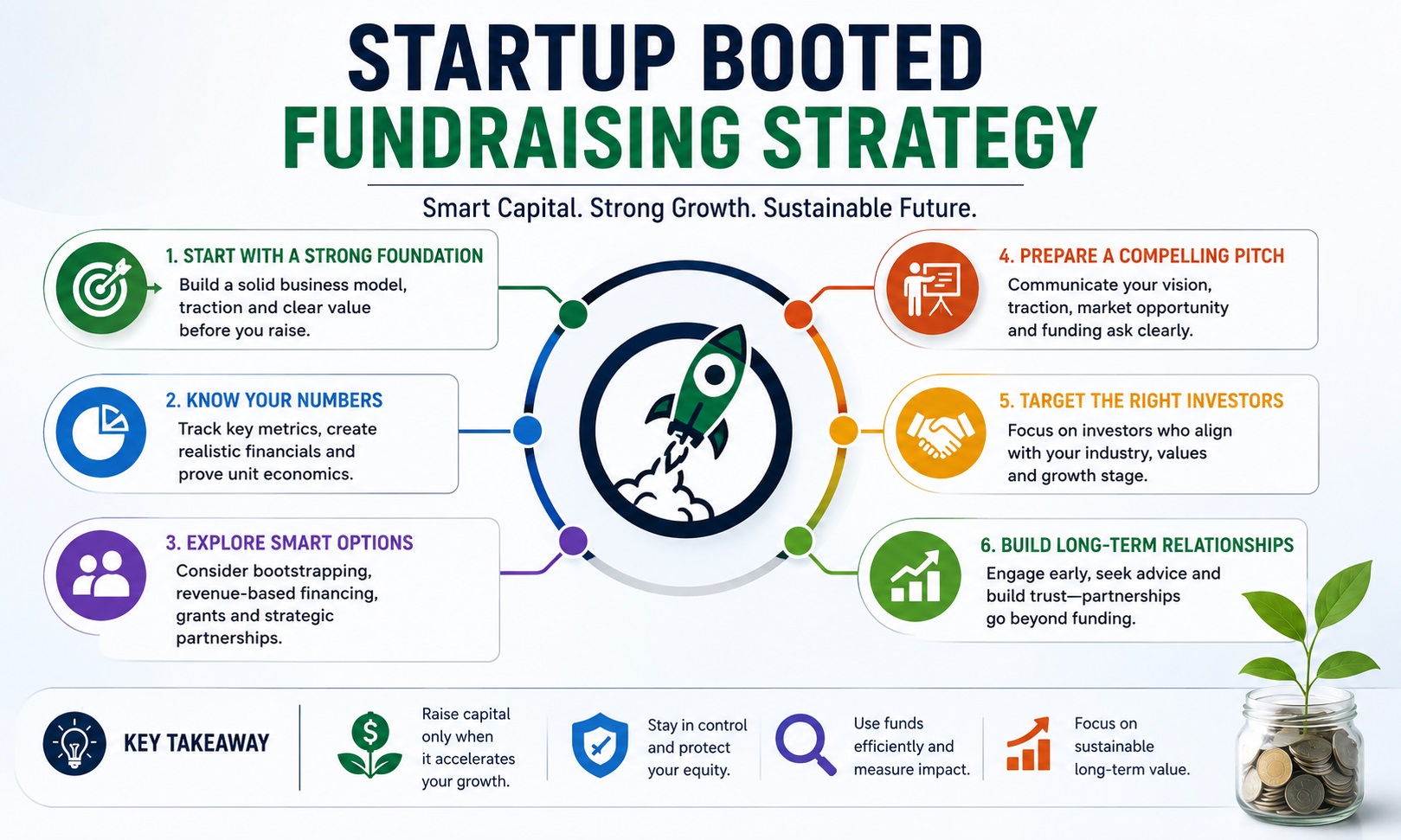
This startup took two powerful trends and combined them into a single, innovative fundraising strategy.
- Bootstrapping first
- Fundraising later
Startups often stay off capital for as long as possible, burning only through customers’ revenue, founders’ savings and minimal overheads. But as growth and product/market fit are achieved, the startup then raises more capital to keep the momentum going.
This pricing methodology is often used by SaaS startups. Since SaaS businesses have some of the characteristics outlined to the left, they are naturally suited to the right pricing model.
- Lower operating costs
- Recurring subscription revenue
- Scalable business models
- Faster MVP development cycles
Rather than burning loads of venture capital while trying to figure things out, failed startups show what hasn’t met enough demand.
Why SaaS Startups Are Choosing Bootstrapped Growth
The SaaS industry naturally fits the bootstrapped model.
What is often not immediately understood is that compared to hardware startups or traditional manufacturing businesses, SaaS companies can easily and profitably launch products and sustain phenomenal growth with very small teams of founders. Most founders start their careers with this mantras:
- A no-code MVP
- Freelance developers
- Cloud-based infrastructure
- Remote teams
This keeps costs low during the early stages.
Investors are no longer simply looking for explosive growth. Today, they are also expecting startups to be profitable. This is reflected in recent startup funding trends, where many venture capital firms are expecting companies to have efficient growth metrics before they invest.
The Biggest Benefits of a Startup Booted Fundraising Strategy
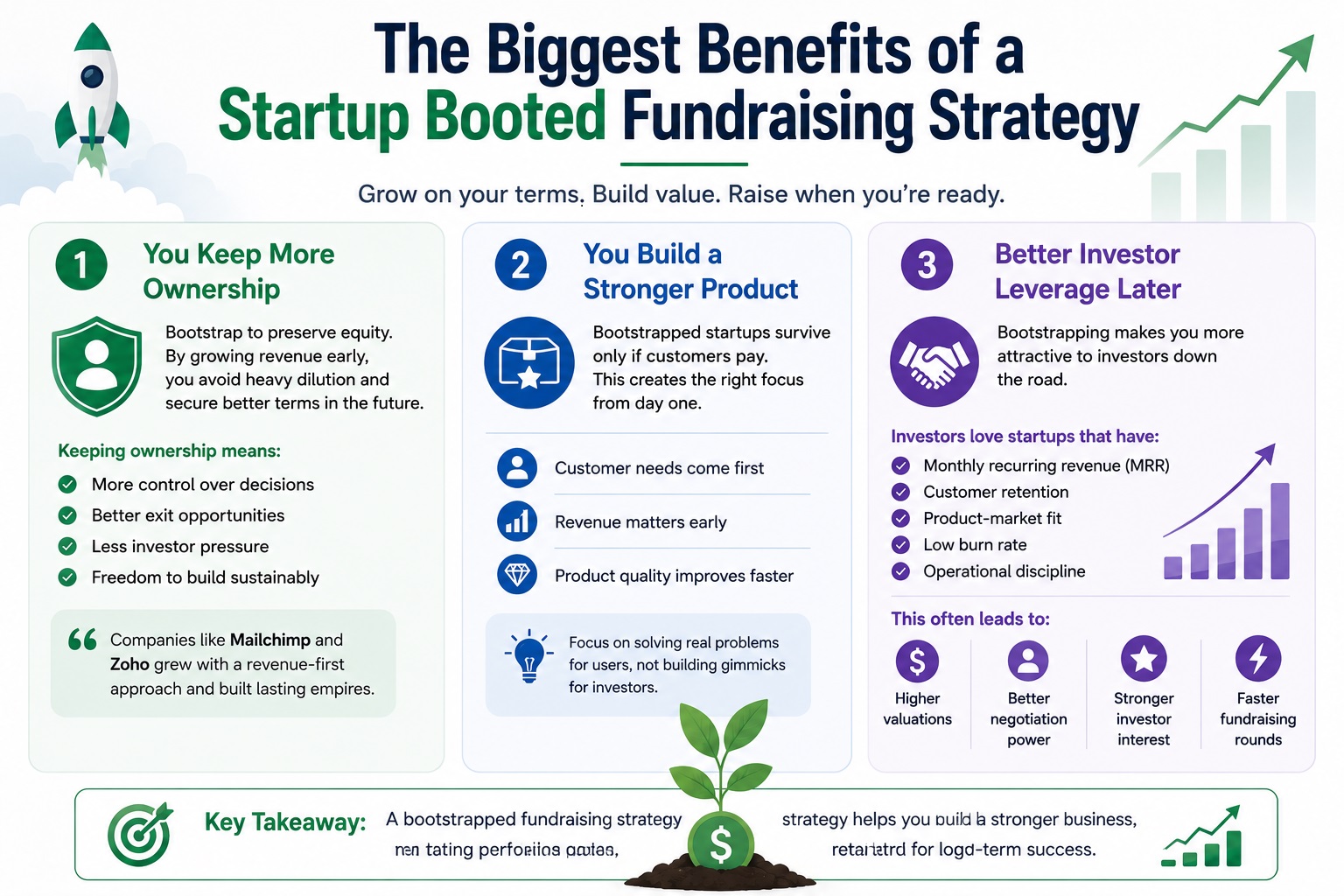
1. You Keep More Ownership
A major reason that founders choose to bootstrap their startup over pursuing venture capital is equity preservation.
When it comes to fundraising for early-stage startups, founders typically end up diluting a large chunk of ownership at an unfavorable valuation. However, by generating more revenue, the company is better positioned to secure better funding terms in the future.
For the SaaS founder, this is going to be extremely important long term.
Keeping ownership means:
- More control over decisions
- Better exit opportunities
- Less investor pressure
- Freedom to build sustainably
Most legendary companies, including Mailchimp and Zoho, have followed a revenue-first growth path before reaching tremendous success.
2. You Build a Stronger Product
Bootstrapped startups survive only if customers actually pay.
That creates an important mindset shift:
- Customer needs come first
- Revenue matters early
- Product quality improves faster
Rather than building gimmicks for Venture Capital investors, founders should focus on solving real problems for users.
3. Better Investor Leverage Later
Ironically, bootstrapping can make fundraising easier later.
Investors love startups that already demonstrate:
- Monthly recurring revenue (MRR)
- Customer retention
- Product-market fit
- Low burn rate
- Operational discipline
Startups that are already generating revenue are viewed by investors as a lower risk and thus less complex to acquire than a standalone operating business.
That often leads to:
- Higher valuations
- Better negotiation power
- Stronger investor interest
- Faster fundraising rounds
Startup Booted Financial Modeling Guide 2026
Key Stages of a Startup Booted Fundraising Strategy
Stage 1: Build a Lean MVP
Your first goal is not perfection.
It is validation.
Most successful SaaS startups start from a Minimum Viable Product (MVP) that directly addresses only one customer problem by implementing the most basic set of features that are necessary to deliver value to customers. Also, successful software startups engage early in fast market testing and customer feedback to survive in their early days.
Focus on:
- One target audience
- One core solution
- Fast deployment
- Quick customer feedback loops
Don’t over-invest in fancy branding, large offices, or large teams before you have an actual product or meaningful revenue.
Stage 2: Generate Early Revenue
Revenue changes everything.
There is clear market demand for this service, even if only a handful of customers are paying for it.
As a SaaS startup you should be spending most of your time and resources on the following items.
- Monthly recurring revenue
- Customer retention
- Organic growth
- Referral systems
- Affordable acquisition channels
Having a bootstrapped startup with 100 Loyal Paying Users typically equals having the upper hand over a heavily funded startup with thousands of Free Users with no revenue model.
Stage 3: Optimize Operations
Once revenue begins flowing, founders need discipline.
Without investment, bootstrapped startups survive by keeping their burn rate low and running a lean operation. Careful budgeting is key, and it’s best to grow at a pace that ensures long-term sustainability rather than short-term gains.
That means:
- Hiring slowly
- Automating processes
- Reducing unnecessary subscriptions
- Reinvesting profits strategically
So far, most SaaS founders have ended up burning down too much money before their revenue grew sufficiently to keep the operation afloat.
Stage 4: Fundraise Strategically
This is where Booted fundraising comes in.
Unlike established companies, which fight to survive and then look to fundraise, startups fight to grow faster – and fundraise to that end.
At this point, founders typically already have:
- Revenue traction
- User growth
- Analytics
- Market validation
- Clear business models
There is little venture capital funding available for purely idea-based startups, and much more available to fund successful and proven startups with real, sustainable, product or customer driven traction.
4 Tips to Good Personal Finance
Common Funding Options for Bootstrapped SaaS Startups
Angel Investors
Angel investors are often the first external funding source.
They usually invest in:
- Early-stage startups
- Founders with traction
- Niche SaaS products
- High-growth potential markets
The advantage is flexibility and mentorship.
Venture Capital
VC funding becomes relevant once startups show scalable growth potential.
However, founders should understand the tradeoff:
- Faster scaling
- Larger capital access
- Increased pressure for aggressive growth
Many founders today are cautious about taking VC money too early because of growth expectations and reduced founder control.
Revenue-Based Financing
This option is growing rapidly in SaaS.
Instead of giving away equity, startups repay investors through a percentage of future revenue.
It works well for:
- Subscription businesses
- Predictable revenue models
- Moderate growth companies
Mistakes Founders Should Avoid
Raising Too Early
Many founders believe fundraising equals success.
It doesn’t.
Premature fundraising often results in:
- Bad valuations
- Excessive dilution
- Investor pressure
- Unsustainable scaling
As entrepreneur Mark Cuban famously suggested, raising money creates obligations, not accomplishments.
Ignoring Product-Market Fit
A weak product cannot be saved by funding.
Research on software startup failures repeatedly highlights the importance of understanding customer problems before scaling aggressively.
Before fundraising, startups should prove:
- Customers genuinely need the product
- Users return consistently
- Revenue grows steadily
Burning Cash Too Fast
Some startups receive funding and immediately increase spending.
That is dangerous.
Smart SaaS founders continue operating lean even after raising capital.
Marketable Investments: Marketing Vs. Finance Office Design
Best Metrics Investors Want to See
If you plan to fundraise in the future, consider now tracking the following metrics to gauge your organization’s progress.
- Monthly Recurring Revenue (MRR)
- Annual Recurring Revenue (ARR)
- Customer Acquisition Cost (CAC)
- Customer Lifetime Value (LTV)
- Churn Rate
- Burn Rate
- Retention Rate
This will give the investors an idea about your startup’s potential for growth and sustainability.
The Future of Startup Fundraising
The startup ecosystem is shifting toward efficiency.
There’s a shift in valuation multiple in tech investing: no longer are companies with crazy growth given infinite valuations in exchange for marginal improvement in customer acquisition. Instead, investors are placing a far greater premium on organizations with healthy, sustainable growth, a solid grasp of unit economics, and meaningful, valuable revenue models.
For SaaS and tech startups, the startup booted fundraising strategy offers the best of both worlds. This approach can keep founders informed about the fund-raising landscape and provide the recognition a startup needs.
- Independence during early growth
- Strategic funding when scaling matters most
It allows founders to build real companies on actual customer value instead of hollow hype.
But in today’s competitive marketplace, “business as usual” may be your best option.
 About Carson Derrow

