Building a startup without external funding can be both rewarding and challenging. While bootstrapped businesses enjoy greater control and ownership, they must also operate with limited financial resources. Every hiring decision, marketing campaign, software purchase, and expansion plan can significantly impact the company’s future. This is where startup booted financial modeling becomes essential.
Startup booted financial modeling is the process of creating financial forecasts and projections specifically for self-funded startups. It helps founders understand how money flows through the business, anticipate future financial needs, and make informed decisions based on realistic assumptions rather than guesswork.
For entrepreneurs who rely on personal savings, early revenue, or reinvested profits to grow their businesses, a strong financial model acts as a roadmap. It provides clarity, reduces uncertainty, and enables sustainable growth without relying heavily on outside investors.
Table of Contents
Understanding Startup Booted Financial Modeling
Startup booted financial modeling refers to the creation of structured financial projections for startups that are funded primarily through founder capital and business-generated revenue. Unlike venture-backed companies that often prioritize aggressive growth over profitability, bootstrapped startups must carefully balance growth with financial sustainability.
A financial model combines assumptions, historical data, market insights, and projected outcomes to estimate future business performance. It serves as a planning tool that helps founders evaluate different scenarios and understand the financial consequences of strategic decisions.
The primary goal of startup booted financial modeling is to ensure that limited resources are allocated efficiently. Since bootstrapped startups typically lack large cash reserves, financial mistakes can have serious consequences. A well-designed model helps identify potential challenges before they become critical problems.
Why Startup Booted Financial Modeling Is Important
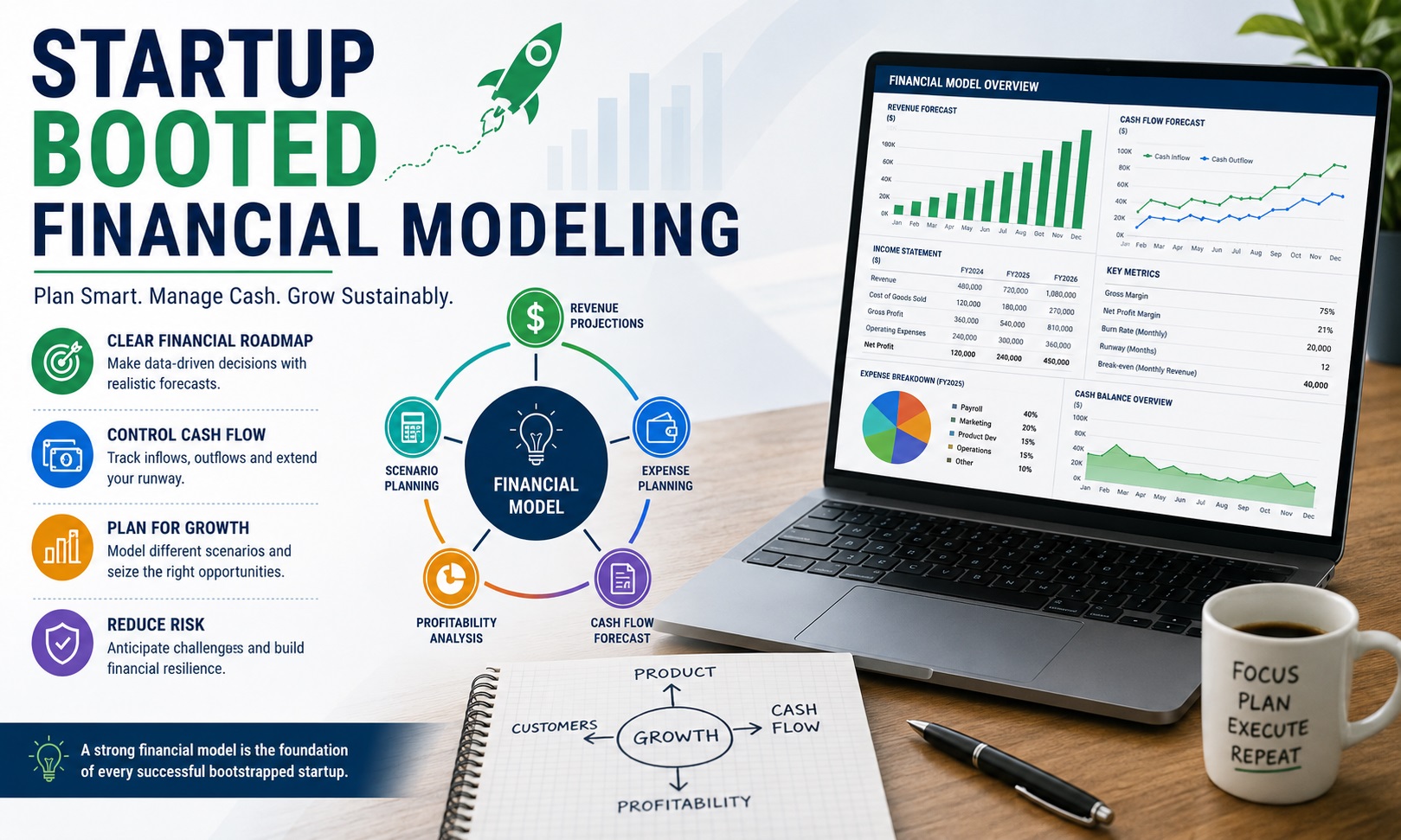
Financial modeling is more than a forecasting exercise. It is a decision-making framework that enables founders to understand the financial health of their businesses.
One of the most important benefits is cash flow visibility. Many startups fail not because they are unprofitable but because they run out of cash. A financial model highlights periods when cash shortages may occur, allowing founders to prepare in advance.
Another advantage is improved budgeting. Instead of making decisions based on intuition, entrepreneurs can use financial projections to determine how much they can safely invest in hiring, marketing, product development, and operations.
Financial modeling also supports strategic planning. Whether launching a new product, entering a new market, or increasing marketing spend, founders can evaluate potential outcomes before committing resources.
Additionally, a strong financial model can become valuable if the company eventually seeks external funding. Investors often request detailed financial forecasts, and having a robust model demonstrates financial discipline and business maturity.
Essential Elements of Startup Booted Financial Modeling
Revenue Forecasting
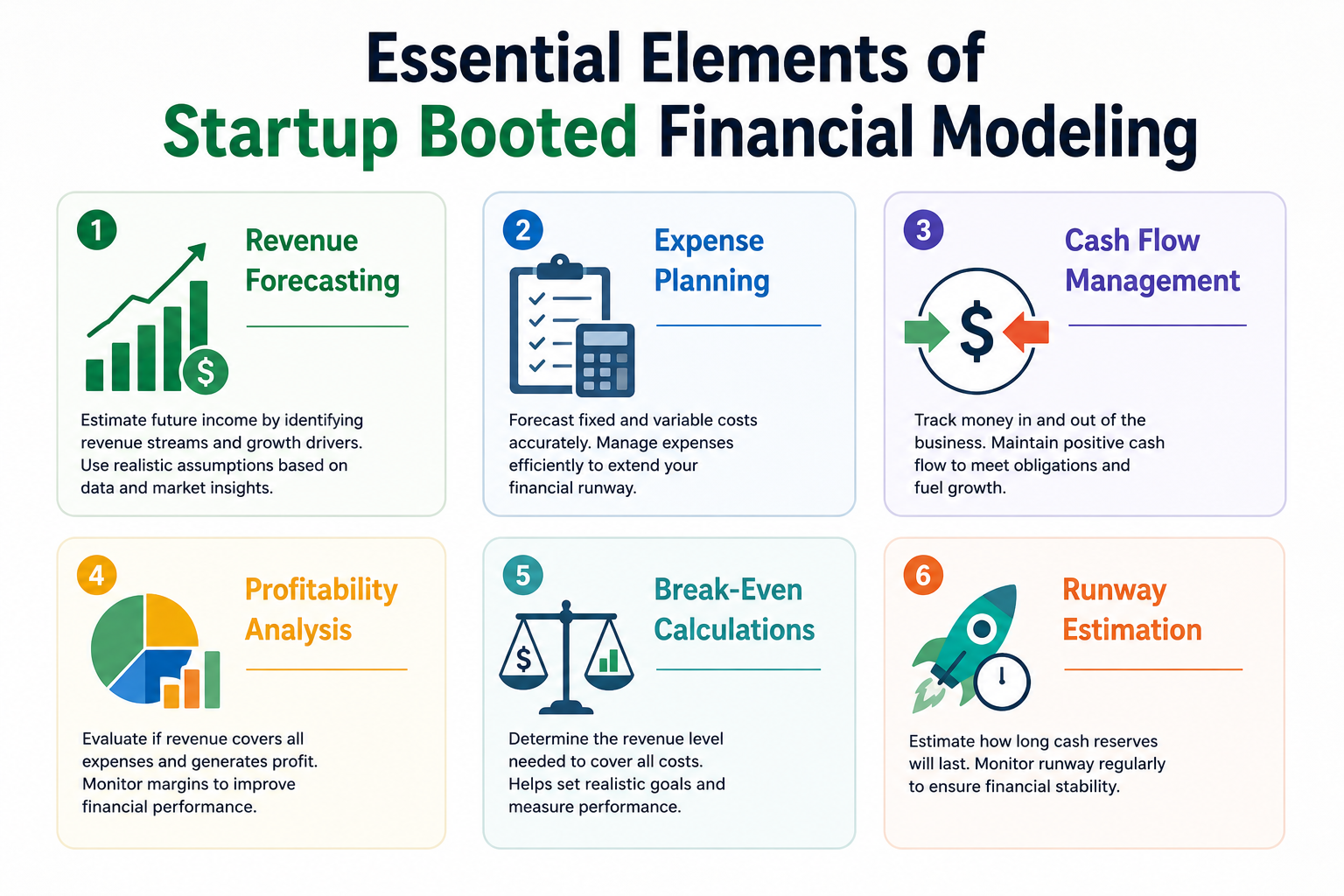
Revenue forecasting is the foundation of every financial model. It estimates how much income the business is expected to generate over a specific period.
Founders should begin by identifying all revenue streams and understanding the factors that influence sales growth. For SaaS businesses, revenue forecasts may focus on subscriptions and recurring payments. E-commerce companies may base forecasts on average order value and customer acquisition rates.
Revenue projections should be realistic and supported by market research, historical performance, and industry benchmarks. Overly optimistic forecasts can lead to poor financial decisions and unrealistic expectations.
Expense Planning
Accurate expense forecasting is equally important. Every business incurs costs that must be carefully managed.
Fixed expenses include costs that remain relatively stable, such as rent, software subscriptions, insurance, and salaries. Variable expenses fluctuate depending on business activity and may include advertising costs, transaction fees, shipping expenses, and contractor payments.
Bootstrapped startups should pay particular attention to operational efficiency. Since resources are limited, controlling unnecessary spending can significantly extend the company’s financial runway.
Cash Flow Management
Cash flow is often considered the most critical component of startup financial planning. It measures how money enters and leaves the business over time.
Positive cash flow ensures that the company can meet its obligations, pay employees, and invest in growth opportunities. Negative cash flow, if sustained for too long, can threaten business survival.
A comprehensive cash flow forecast should track expected revenue, operating expenses, loan repayments, taxes, and capital expenditures on a monthly basis.
Profitability Analysis
Profitability analysis evaluates whether the business generates enough revenue to cover expenses and produce profit.
This section of the financial model typically includes projected income statements showing revenue, cost of goods sold, operating expenses, and net income. Monitoring profitability helps founders identify areas where margins can be improved and costs can be reduced.
Break-Even Calculations
The break-even point represents the level of revenue required to cover all business expenses.
Understanding this metric helps founders determine how much they need to sell before becoming profitable. It also provides a clear benchmark for evaluating business performance and setting realistic growth targets.
Runway Estimation
Runway measures how long a startup can continue operating before exhausting its available cash reserves.
For bootstrapped startups, runway estimation is particularly important because there may be limited access to emergency funding. A financial model should continuously monitor runway to ensure that the company remains financially stable.
How to Build a Foundational Finance Skillset as an Entrepreneur
Building a Startup Booted Financial Model
Step 1: Define Business Goals
Start by establishing clear objectives for the business. Determine whether the primary focus is profitability, growth, market expansion, product development, or customer acquisition. These goals will influence all financial assumptions.
Step 2: Identify Revenue Sources
List every revenue stream and estimate future performance. Consider pricing strategies, customer growth rates, conversion rates, and retention metrics when creating projections.
Step 3: Forecast Operating Expenses
Calculate expected expenses across all business functions, including payroll, marketing, software, infrastructure, and administrative costs. Be conservative when estimating future spending.
Step 4: Create Cash Flow Projections
Develop monthly cash flow forecasts that track incoming revenue and outgoing expenses. This will help identify periods of potential financial stress.
Step 5: Build Multiple Scenarios
Create separate forecasts for best-case, expected-case, and worst-case outcomes. Scenario planning improves preparedness and helps founders respond quickly to changing conditions.
Step 6: Review and Update Regularly
Financial models should be living documents. Review actual results against projections each month and update assumptions as new information becomes available.
Key Metrics in Startup Booted Financial Modeling
Several financial metrics play a critical role in evaluating startup performance.
Monthly Recurring Revenue (MRR) measures predictable monthly income and is particularly valuable for subscription-based businesses. Consistent MRR growth often indicates strong product-market fit.
Customer Acquisition Cost (CAC) calculates how much it costs to acquire a new customer. Founders should continuously optimize marketing efforts to reduce CAC while maintaining growth.
Customer Lifetime Value (CLV) estimates the total revenue generated by a customer throughout their relationship with the business. A healthy business model typically has a CLV significantly higher than CAC.
Gross Margin reflects the percentage of revenue remaining after direct costs. Higher margins generally provide greater flexibility for growth and investment.
Burn Rate measures how quickly cash reserves are being spent. Understanding burn rate helps founders manage runway and avoid unexpected cash shortages.
Net Profit Margin evaluates overall profitability and indicates how efficiently the business converts revenue into profit.
4 Reasons Why Finance Is Important In Businesses Today
Financial Modeling Strategies for Bootstrapped Startups
Successful bootstrapped startups often prioritize profitability from the beginning. Instead of pursuing rapid growth at any cost, they focus on creating sustainable business models.
Lean budgeting is one effective strategy. By minimizing unnecessary expenses and investing only in high-impact initiatives, founders can maximize the value of every dollar spent.
Revenue diversification is another important approach. Depending on a single revenue source can increase risk, while multiple income streams improve financial stability.
Regular scenario planning also strengthens resilience. Market conditions can change quickly, and startups that prepare for multiple outcomes are often better positioned to navigate uncertainty.
Common Challenges and Solutions
Many founders struggle with overly optimistic revenue projections. While ambition is important, financial models should be grounded in realistic assumptions supported by data.
Unexpected expenses are another common challenge. Establishing contingency reserves can help businesses absorb unforeseen costs without disrupting operations.
Cash flow management often becomes difficult during growth phases. Rapid expansion may require upfront investments before additional revenue is realized. Detailed cash flow forecasting helps address this challenge.
Another issue is failing to update the model regularly. Outdated assumptions reduce accuracy and limit the model’s usefulness as a decision-making tool.
Tools Used for Startup Booted Financial Modeling
Modern startups have access to numerous financial planning tools. Spreadsheet software remains popular because of its flexibility and affordability. Many founders begin with Excel or Google Sheets before adopting specialized financial planning platforms.
Advanced software solutions can automate forecasting, reporting, and scenario analysis. These tools become increasingly valuable as businesses grow and financial complexity increases.
Best Practices for Startup Booted Financial Modeling
The most effective financial models are built on realistic assumptions rather than optimistic expectations. Conservative forecasting helps reduce risk and improves decision quality.
Founders should compare actual performance against forecasts regularly. This practice improves forecasting accuracy over time and highlights areas that require attention.
Maintaining multiple scenarios is also essential. Business conditions rarely unfold exactly as planned, and scenario-based planning provides flexibility.
Transparency and simplicity are equally important. A model should be detailed enough to provide insight but simple enough to understand and maintain.
Steps to Finance Your Business Expansion
Real-World Startup Booted Financial Modeling Example
Consider a software startup launched with $25,000 in founder savings. The company begins with a subscription-based product generating $2,000 in monthly recurring revenue.
Using financial modeling, the founders project customer growth, operating costs, and future cash flow. Their model reveals that increasing marketing spend by 20% could accelerate growth but would reduce runway significantly.
After evaluating different scenarios, they choose a more conservative growth strategy that prioritizes profitability. Within two years, the company reaches sustainable positive cash flow without raising external capital.
This example illustrates how financial modeling can support informed decision-making and long-term business success.
Frequently Asked Questions
What is Startup Booted Financial Modeling?
It is the process of creating financial forecasts and projections for startups that are funded primarily through founder capital and business-generated revenue.
Why is financial modeling important for bootstrapped startups?
It helps founders manage cash flow, plan growth, reduce risk, and make informed financial decisions.
How often should a startup update its financial model?
Most startups should review and update their financial models monthly to ensure projections remain accurate.
Which metrics should founders track most closely?
Cash flow, runway, customer acquisition cost, customer lifetime value, recurring revenue, and profit margins are among the most important metrics.
Can startups create financial models without investors?
Yes. In fact, financial modeling is often more important for bootstrapped startups because they must manage limited resources carefully.
Conclusion
Startup booted financial modeling is one of the most valuable tools available to self-funded entrepreneurs. It provides visibility into future financial performance, supports strategic planning, and helps founders avoid costly mistakes. By forecasting revenue, managing expenses, tracking key metrics, and preparing for multiple scenarios, bootstrapped startups can build sustainable businesses without relying heavily on outside capital.
A strong financial model does not guarantee success, but it significantly improves the likelihood of making informed decisions and achieving long-term growth. For founders committed to building profitable and resilient businesses, financial modeling should be a core part of their operational strategy.
 About Carson Derrow

