As artificial intelligence, edge computing, and connected devices continue to evolve, new computing platforms are emerging that promise faster processing, stronger security, and greater efficiency. One technology attracting attention is FHOGIS930.5Z.
Although FHOGIS930.5Z is not yet recognized as an official commercial standard, it is increasingly referenced in discussions surrounding advanced computing systems, AI-driven automation, and future-ready digital infrastructure. It represents the growing demand for intelligent, scalable, and secure computing solutions designed to handle tomorrow’s technological challenges.
This article explains what FHOGIS930.5Z is, its potential applications, core features, benefits, possible limitations, and why it could play a role in the future of smart computing.
Table of Contents
What Is FHOGIS930.5Z?
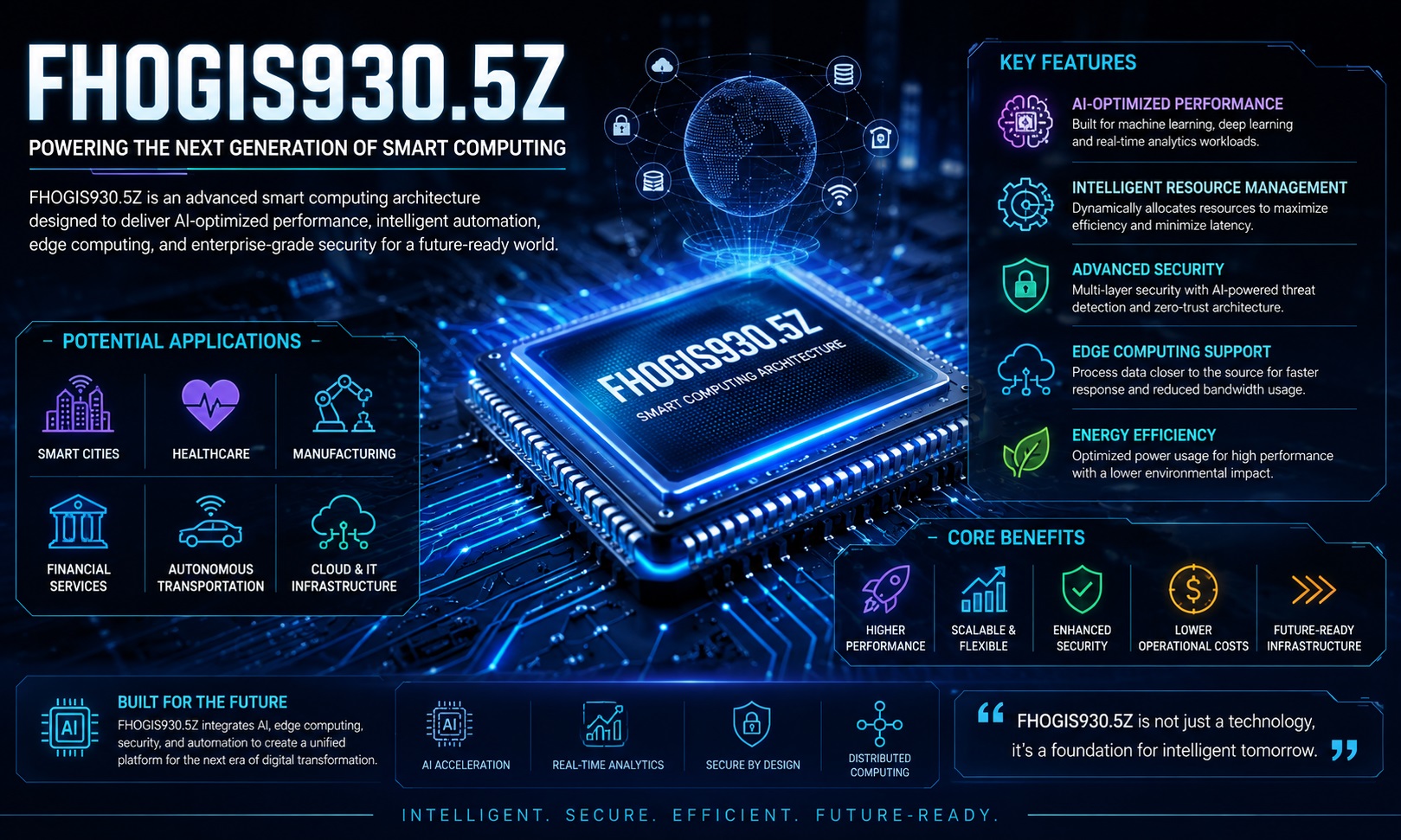
FHOGIS930.5Z can be described as a conceptual next-generation computing architecture designed to combine high-performance processing with intelligent automation. Rather than functioning as a traditional processor alone, the framework integrates AI capabilities, cloud connectivity, cybersecurity, and real-time analytics into a unified computing environment.
The concept aligns with broader industry trends toward AI-native infrastructure, edge computing, and energy-efficient processing. Technology forecasts also point toward increasing adoption of intelligent computing systems capable of autonomous decision-making and distributed workloads.
Instead of relying solely on centralized servers, FHOGIS930.5Z envisions computing resources working together across cloud platforms, edge devices, and intelligent networks.
Key Features of FHOGIS930.5Z
AI-Optimized Performance
One of the defining characteristics of FHOGIS930.5Z is its focus on artificial intelligence. The architecture is designed to accelerate machine learning tasks, predictive analytics, and automated decision-making.
This makes it suitable for industries that rely on large-scale data processing.
Intelligent Resource Allocation
Rather than assigning computing resources manually, FHOGIS930.5Z can dynamically distribute workloads based on demand, improving efficiency while minimizing latency.
Advanced Security Architecture
Modern cyber threats require more than antivirus software.
FHOGIS930.5Z emphasizes:
- Multi-layer security
- AI-powered threat detection
- Secure authentication
- Encrypted data transmission
- Zero-trust security principles
These capabilities reflect broader industry movement toward trusted computing and confidential computing environments.
Edge Computing Support
Instead of sending every request to distant cloud servers, FHOGIS930.5Z processes information closer to where data is generated.
Benefits include:
- Faster response times
- Lower bandwidth usage
- Improved reliability
- Better support for IoT devices
Energy Efficiency
With data centers consuming increasing amounts of electricity, energy-efficient computing has become a major priority.
FHOGIS930.5Z incorporates intelligent workload optimization to reduce unnecessary power consumption while maintaining high performance.
Potential Applications
Smart Cities
Municipal infrastructure generates enormous amounts of information every second.
FHOGIS930.5Z could support:
- Traffic optimization
- Intelligent surveillance
- Public safety
- Utility management
- Environmental monitoring
Healthcare
Healthcare organizations increasingly depend on AI for diagnosis and patient monitoring.
Potential applications include:
- Medical imaging
- Patient analytics
- Remote monitoring
- Hospital automation
- Clinical decision support
Manufacturing
Factories adopting Industry 4.0 technologies require intelligent computing systems capable of processing sensor data in real time.
FHOGIS930.5Z could assist with:
- Predictive maintenance
- Robotics
- Supply chain optimization
- Quality control
- Equipment monitoring
Financial Services
Banks and financial institutions process millions of secure transactions every day.
Possible uses include:
- Fraud detection
- Risk assessment
- Customer behavior analysis
- Algorithmic trading
- Secure payment processing
Autonomous Transportation
Connected vehicles require instant decision-making with minimal latency.
An architecture like FHOGIS930.5Z could improve:
- Vehicle communication
- Navigation
- Driver assistance systems
- Traffic coordination
- Fleet management
Benefits of FHOGIS930.5Z
Organizations adopting intelligent computing systems similar to FHOGIS930.5Z may experience several advantages.
Improved Processing Speed
Optimized hardware and AI acceleration reduce delays during complex computational tasks.
Better Scalability
The system can expand alongside growing business requirements without requiring a complete infrastructure redesign.
Enhanced Security
Integrated cybersecurity measures protect sensitive information while reducing operational risks.
Lower Operational Costs
Automation and intelligent resource management help organizations reduce infrastructure expenses over time.
Future-Ready Infrastructure
The architecture is designed to accommodate emerging technologies including AI agents, IoT, robotics, and distributed computing.
Challenges to Consider
Like many emerging technologies, FHOGIS930.5Z may face certain obstacles before widespread adoption.
These include:
- High implementation costs
- Complex system integration
- Need for skilled professionals
- Compatibility with existing infrastructure
- Ongoing cybersecurity updates
Organizations must carefully evaluate these factors before deployment.
How FHOGIS930.5Z Compares with Traditional Computing
| Feature | Traditional Systems | FHOGIS930.5Z |
|---|---|---|
| AI Integration | Limited | Built into architecture |
| Processing | Mostly centralized | Distributed and intelligent |
| Security | Reactive | AI-assisted and proactive |
| Scalability | Moderate | Highly scalable |
| Edge Computing | Limited | Native support |
| Automation | Low | Extensive |
| Resource Management | Manual | Dynamic and automated |
Future Outlook
Industry experts predict that computing will increasingly combine AI, edge processing, energy efficiency, and secure distributed infrastructure. Reports from technology organizations suggest that autonomous AI systems, advanced hardware, and intelligent cloud-edge integration will shape the next generation of computing platforms.
Whether FHOGIS930.5Z becomes an actual commercial platform or remains a conceptual model, it reflects many of the innovations expected to define future digital ecosystems.
Frequently Asked Questions
Is FHOGIS930.5Z a real technology?
At present, FHOGIS930.5Z appears to be a conceptual or emerging technology reference rather than an officially recognized industry standard. It is generally discussed in the context of future smart computing concepts.
What industries could benefit from FHOGIS930.5Z?
Potential sectors include healthcare, finance, manufacturing, transportation, telecommunications, smart cities, and cloud computing.
Does FHOGIS930.5Z use artificial intelligence?
Yes. AI-powered automation, predictive analytics, and intelligent resource management are considered central components of the architecture.
Why is edge computing important?
Edge computing reduces latency by processing information closer to where it is generated, enabling faster responses for connected devices and real-time applications.
Is FHOGIS930.5Z suitable for small businesses?
If commercial implementations become available, scalable deployment options could allow both enterprises and smaller organizations to benefit from its intelligent computing capabilities.
Conclusion
FHOGIS930.5Z represents the direction modern computing is heading—toward systems that are intelligent, secure, scalable, and optimized for AI-driven workloads. While it is not currently an established industry standard, the concepts associated with FHOGIS930.5Z closely mirror the technologies shaping the future of digital infrastructure, including edge computing, autonomous AI, advanced cybersecurity, and sustainable processing.
Businesses that stay informed about these evolving trends will be better positioned to adopt the next generation of smart computing solutions as they mature.
 About Carson Derrow

