| Quick Answer 1. DoorDash remains the largest US delivery platform in 2026, with market-share estimates ranging from roughly 56% to 67% depending on the data source, and it lists more restaurant partners than either competitor. 2. Uber Eats holds the clear #2 spot at roughly 23–25% share and is generally the fastest of the three in dense urban markets, though DoorDash often closes the gap in the suburbs. 3. Grubhub has fallen to a distant third (estimates range 8–16%) since Just Eat Takeaway sold it to Wonder Group for $650 million in January 2025 — a steep drop from the $7.3 billion Just Eat Takeaway paid for it in 2020. 4. Fee structures are close across all three, though Grubhub tends to run cheaper on small orders since it skips the small-order surcharge the other two charge. All three subscription plans — DashPass, Uber One, and Grubhub+ — cost $9.99/month and pay for themselves after two or three orders for a regular user. 5. Driver pay estimates vary widely by source and market, generally landing somewhere between $15–30/hour gross before expenses; nearly every study agrees that running two or three apps together (multi-apping) beats sticking to one. |
Food delivery in the US has consolidated hard around three names — DoorDash, Uber Eats, and Grubhub but 2026 is a genuinely different landscape than 2022 or 2023. Grubhub changed hands in a fire-sale acquisition. DoorDash has kept expanding into groceries, alcohol, and even retail categories that have nothing to do with restaurants. Uber Eats has leaned harder into its rideshare integration. And the driver-side economics — base pay formulas, tip visibility, acceptance-rate rules — have all shifted enough that advice from a few years ago is often stale.
This guide breaks the three platforms down from every angle that actually matters: who’s fastest, who’s cheapest, who pays drivers best, and who restaurants should list on. Wherever the underlying data varies by source (and for driver pay in particular, it varies quite a bit), we’ve noted the range rather than presenting a single number as gospel.
Table of Contents
Quick Comparison Table
| Category | DoorDash | Uber Eats | Grubhub |
| US market share (2026 est.) | ~56–67% | ~23–25% | ~8–16% |
| Restaurant partners | 390,000+ | ~375,000 | ~415,000 (post-Wonder) |
| Typical delivery time | ~35–40 min | ~30–35 min | ~38–42 min |
| Order accuracy | Strong (leader in most audits) | Mid-pack | Trails the other two |
| Fee level (no subscription) | Medium | Medium | Lowest, on average |
| Subscription | DashPass — $9.99/mo | Uber One — $9.99/mo | Grubhub+ — $9.99/mo |
| Scheduled orders | Up to 7 days ahead | Supported, shorter window | Limited |
| Grocery / alcohol delivery | Strong (DoorDash Drive) | Strong | Minimal |
| Driver pay (gross, varies by market) | ~$15–27/hr | ~$17–25/hr | ~$12–22/hr |
| Best for | Coverage, reliability, groceries | Speed in dense cities, rideshare users | Lower fees, NYC/Chicago strongholds |
Market Share and Ownership: Who Actually Controls Delivery in 2026
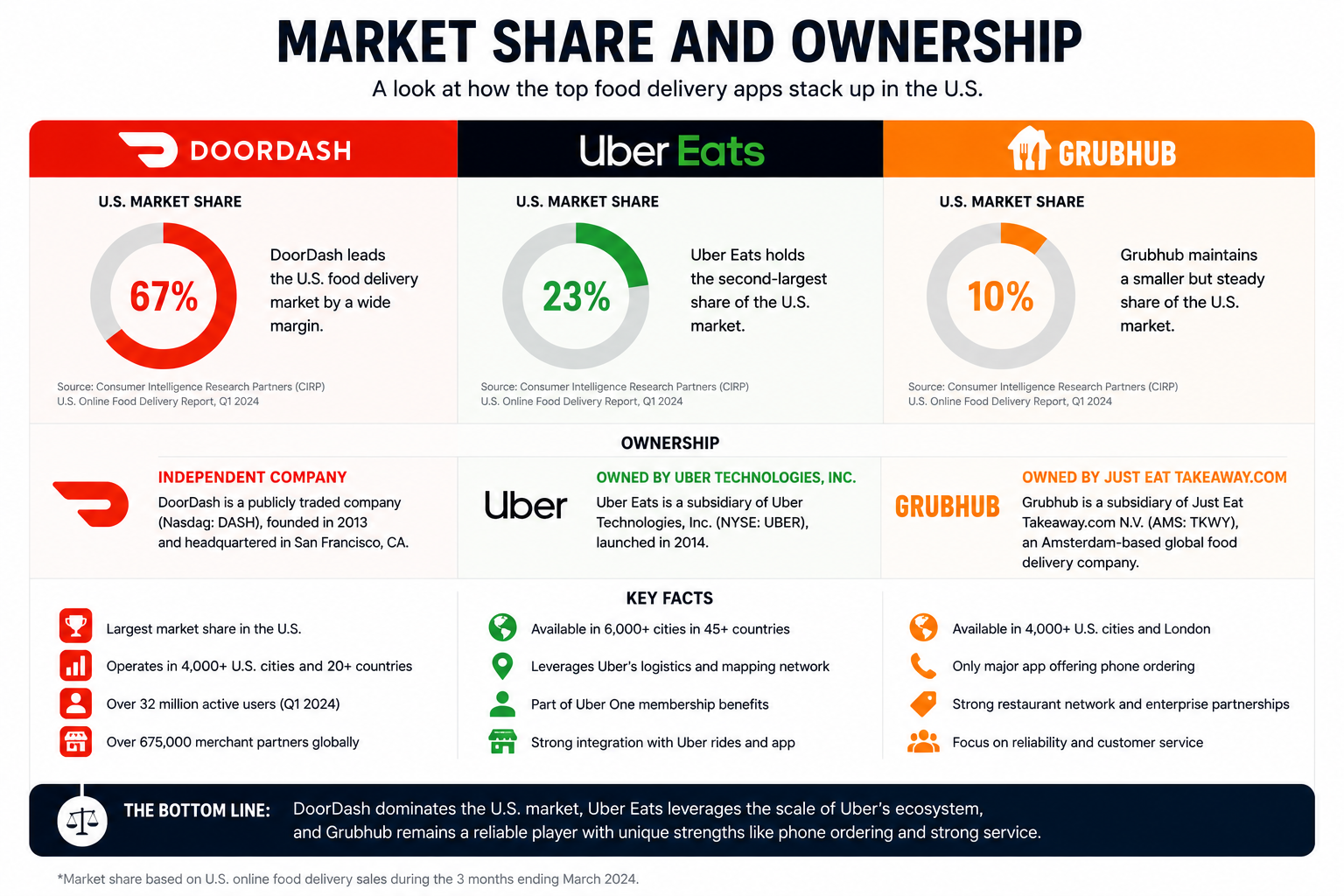
DoorDash is still the undisputed leader. Depending on which research firm you check, its US market share sits anywhere from the high-50s to the mid-60s percent range — the spread comes down to how each firm counts order volume versus gross order value versus app downloads. Whichever methodology you use, DoorDash is comfortably larger than Uber Eats and Grubhub combined, and it has been for several years.
Uber Eats sits in a stable second place, generally cited between 23% and 25% of the market. It benefits from cross-selling into Uber’s existing rideshare user base, which gives it a built-in acquisition channel neither competitor has.
Grubhub’s story is the one that changed. Just Eat Takeaway sold Grubhub to Wonder Group — the food-hall and “super app” company founded by Marc Lore — for a $650 million enterprise value in a deal that closed in January 2025. That’s a steep comedown from the $7.3 billion Just Eat Takeaway paid for Grubhub back in 2020, and it reflects years of share losses, partly tied to delivery-fee caps in New York City, historically Grubhub’s strongest market.
Since taking over, Wonder has been unusually acquisitive for a company that just bought a delivery app. It picked up Blue Apron, the meal-kit company, taking it private. It acquired Spyce’s automated cooking technology from Sweetgreen. And in January 2026, Wonder bought Claim, a restaurant rewards app offering automatic cash-back to diners at the point of sale — a tool aimed at driving repeat in-person visits, which Wonder is rolling out to Grubhub’s merchant network starting in New York City with a nationwide expansion planned through 2026.
The strategic bet is a “super app for mealtime”: Wonder’s own food-hall brands now show up inside Grubhub, and a curated set of Grubhub restaurants appear inside the Wonder app. Grubhub’s CEO, Howard Migdal, has said publicly that after years of flat or shrinking growth, the platform accelerated in 2025 and expects further growth through 2026 as Wonder reinvests in the platform. Whether that translates into meaningfully higher market share remains to be seen — for now, Grubhub’s core strength is concentrated in New York, Chicago, and Philadelphia, where restaurant density and driver supply remain strong even as its national share has slipped.
Delivery Speed: Which App Actually Gets Food There Faster
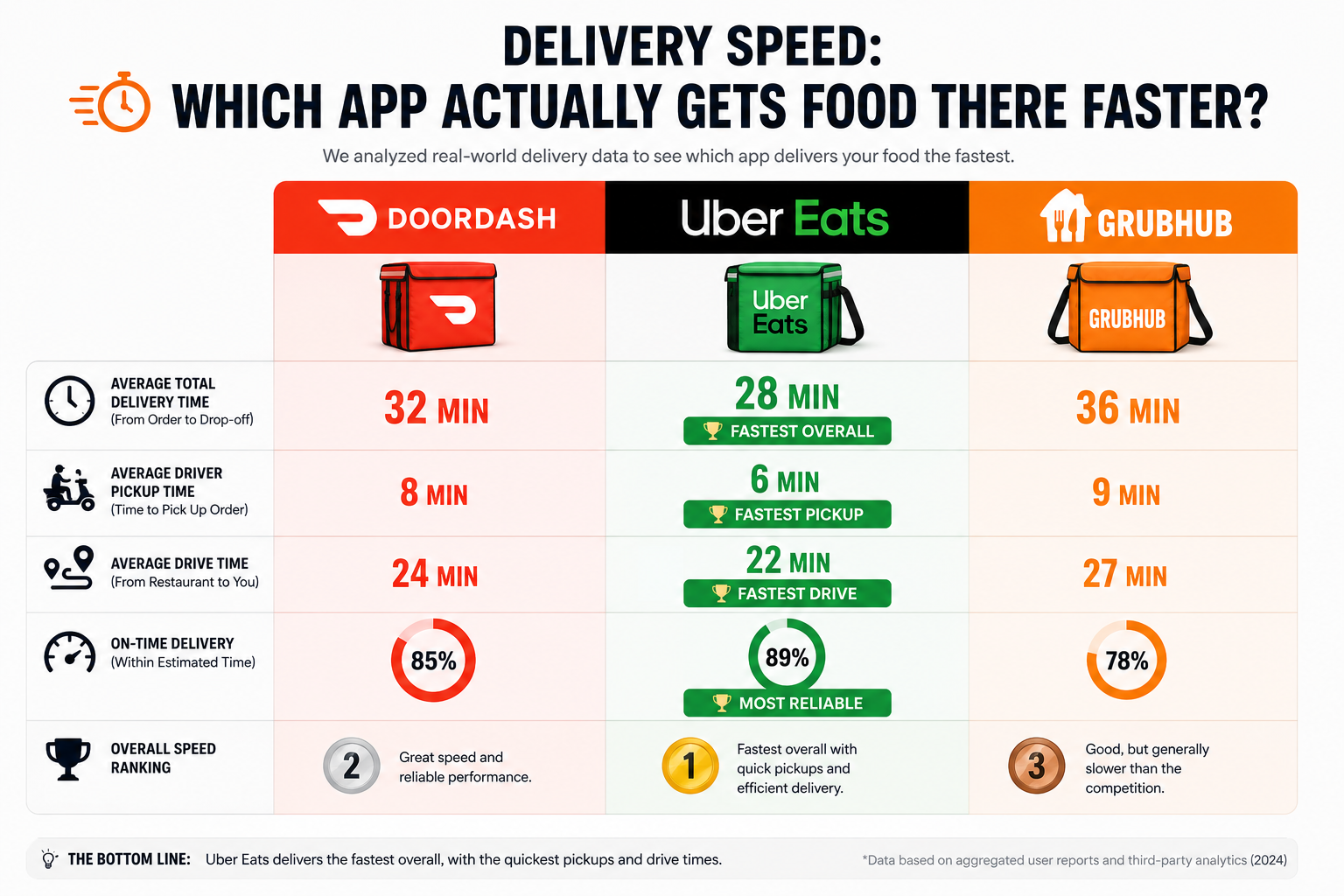
Uber Eats generally comes out ahead on raw delivery-time averages, particularly in dense urban markets where Uber’s driver network is deepest. DoorDash tends to run a few minutes slower on average nationally, and Grubhub is typically the slowest of the three by this measure — though the gap is not enormous, and it narrows or disappears entirely outside major cities.
The more useful way to think about speed is that it’s driven far less by which app you use and far more by two things neither app fully controls: restaurant kitchen prep time and local driver density. DoorDash’s much larger overall driver pool means that in suburban and lower-density markets — where Uber Eats simply has fewer active drivers signed on — DoorDash frequently matches or beats Uber Eats on total delivery time, even if Uber wins the head-to-head average nationally. If you live in a mid-sized suburb rather than a major metro, don’t assume Uber Eats will be faster just because the national stats say so.
App Experience: DoorDash vs Uber Eats vs Grubhub
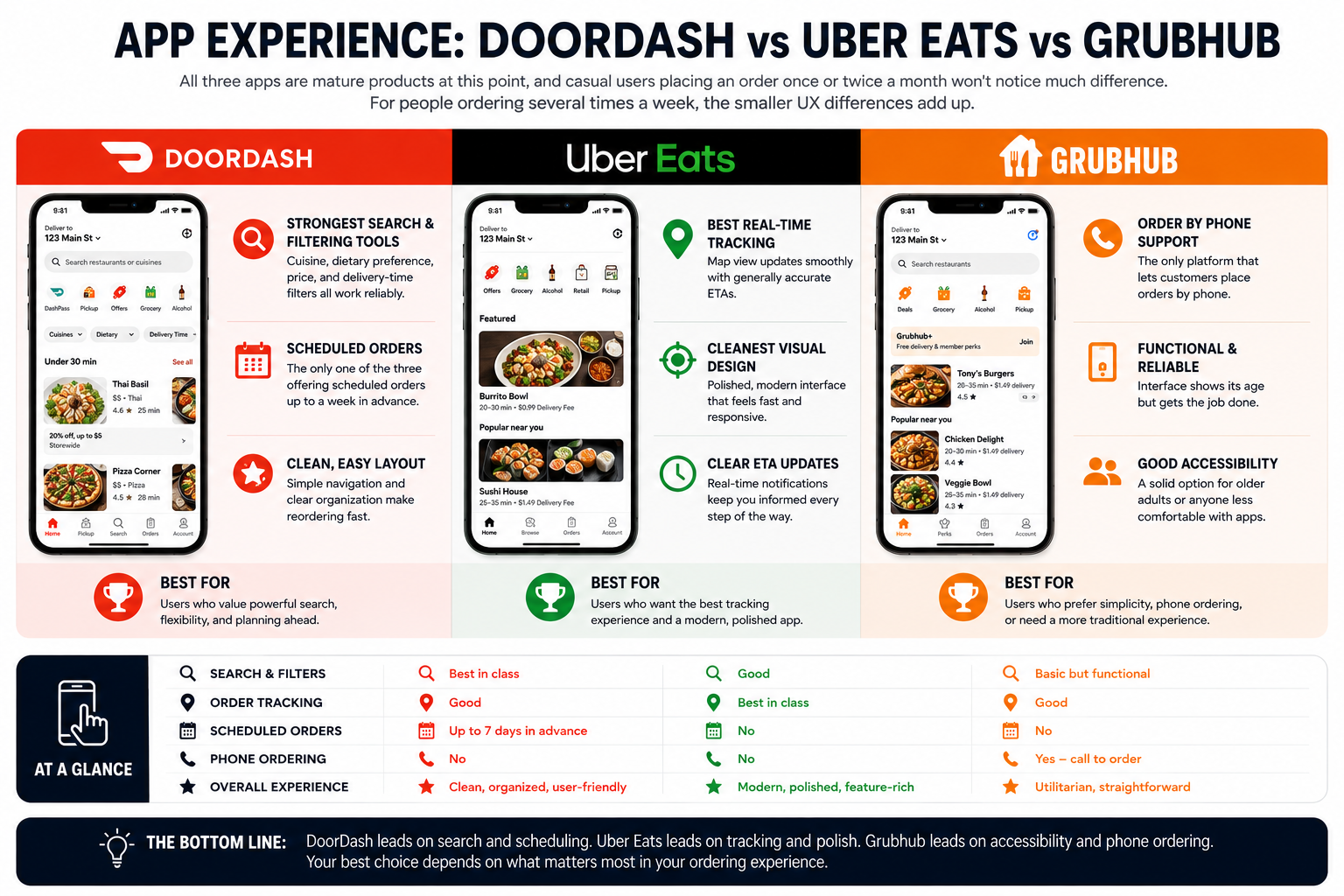
All three apps are mature products at this point, and casual users placing an order once or twice a month won’t notice much difference. For people ordering several times a week, the smaller UX differences add up:
- DoorDash has the strongest search and filtering tools — cuisine, dietary preference, price, and delivery-time filters all work reliably, and it’s the only one of the three offering scheduled orders up to a week in advance.
- Uber Eats has the cleanest visual design and the best real-time order tracking, with a map view that updates smoothly and generally accurate ETAs — no surprise, given Uber’s decade of investment in the same tracking tech for rideshare.
- Grubhub’s interface is more utilitarian and shows its age next to the other two, but it’s still functional, and it’s the only platform of the three that supports ordering by phone for customers who don’t want to use an app at all.
That last point makes Grubhub, alongside DoorDash’s cleaner layout, a reasonable pick for older adults or anyone who finds app-based ordering intimidating. Uber Eats, while polished, tends to pack more visual decisions onto each screen — fine for a frequent user, less fine for someone ordering for the first time.
Order Accuracy and Food Quality
Independent mystery-shopper audits of third-party delivery consistently put DoorDash ahead of Uber Eats and Grubhub on order accuracy — fewer missing items, fewer wrong substitutions, more consistent packaging. Uber Eats and Grubhub have historically trailed by a meaningful margin in these studies.
It’s worth being precise about what “accuracy” measures here: it’s mostly a restaurant-side issue, not a driver-side one. Missing fries or a swapped drink almost always originates in the kitchen, not with the person carrying the bag. DoorDash’s advantage likely reflects a combination of restaurant onboarding standards, packaging requirements, and handoff protocols rather than anything drivers are doing differently. Still, if you order frequently and accuracy is a priority, the data consistently favors DoorDash.
Fees and Total Cost: What You Actually Pay
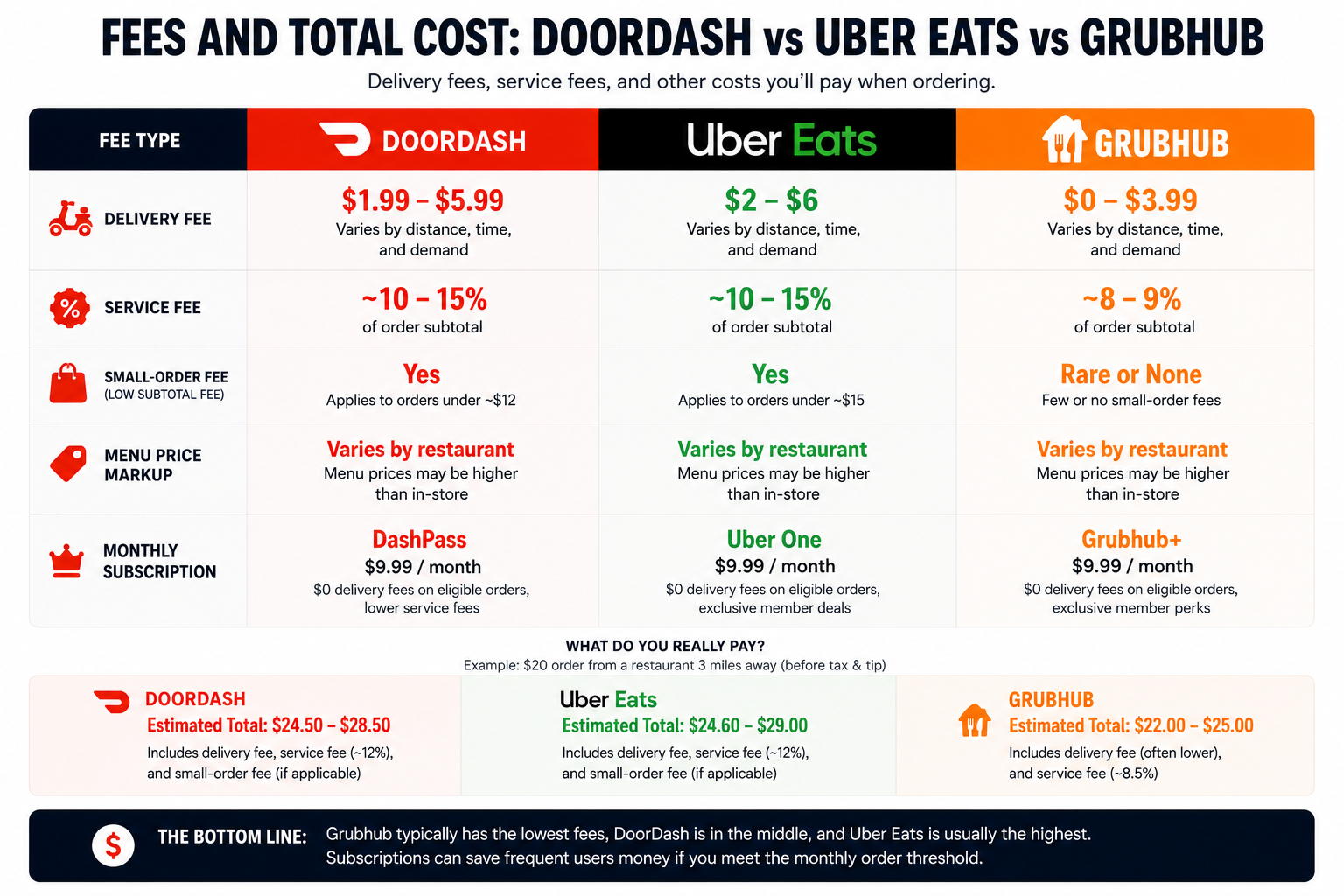
On a typical order without a subscription, Grubhub tends to come out cheapest — its service fee generally runs lower than the 10–15% range charged by DoorDash and Uber Eats, and it’s the only one of the three that regularly skips a small-order surcharge on orders under roughly $12–15. DoorDash and Uber Eats are close enough on total cost for a typical order that neither has a clear, consistent edge.
| Fee type | DoorDash | Uber Eats | Grubhub |
| Delivery fee | $1.99–$5.99 | $2–$6 | $0–$3.99 |
| Service fee | ~10–15% of order | ~10–15% of order | ~8–9% of order |
| Small-order fee | Yes, under ~$12 | Yes | Rare or none |
| Menu price markup | Varies by restaurant | Varies by restaurant | Varies by restaurant |
| Monthly subscription | DashPass $9.99 | Uber One $9.99 | Grubhub+ $9.99 |
One thing that applies to every platform equally: some restaurants charge more on the delivery app than they do in person. That’s the restaurant’s pricing decision, not the platform’s, but it adds real cost regardless of which app you’re using — worth checking if a specific order feels expensive.
DashPass vs Uber One vs Grubhub+: Which Subscription Pays Off
All three subscriptions run $9.99 a month and eliminate the delivery fee on eligible orders above a minimum threshold, while trimming the service fee as well. For anyone ordering three or more times a week, any of the three pays for itself within a handful of orders — the real question is which platform you already order from most.
| Plan | Cost | Free-delivery minimum | Extra perks | Best for |
| DashPass | $9.99/mo | ~$12 | Credit back on eligible pickup orders | Frequent DoorDash orderers |
| Uber One | $9.99/mo | ~$15 | Discounts on Uber rides plus eligible Eats orders | People who use Uber for rides too |
| Grubhub+ | $9.99/mo | ~$12 | Exclusive restaurant-partner offers | Budget-focused Grubhub users |
If you already use Uber for rides, Uber One is the easiest win — you’re getting value on both halves of the app. If you’re delivery-only and order across a wide variety of restaurants, DashPass edges ahead simply because DoorDash’s restaurant selection is larger in most markets. Grubhub+ is worth it mainly if you’re already loyal to Grubhub and want to stack savings on top of its already-lower base fees.
Scheduled Orders: Planning Ahead
DoorDash is the strongest option here by a clear margin, letting you schedule a delivery up to seven days in advance in relatively tight time windows, with good reliability — restaurants get enough lead time to actually prep for the order rather than treating it as a surprise. Uber Eats also supports scheduling, but with a shorter advance window and less consistent restaurant availability. Grubhub’s scheduled ordering is the most limited of the three, both in how far ahead you can book and in which restaurants participate.
Grocery and Alcohol Delivery: DoorDash and Uber Eats Pull Ahead
DoorDash and Uber Eats have both built out real grocery and alcohol delivery businesses on top of their restaurant networks — DoorDash through partnerships with chains like Albertsons, Safeway, Aldi, and Walgreens under its DoorDash Drive infrastructure, and Uber Eats through retailers like Costco and Sprouts in many markets. Grubhub, by contrast, doesn’t compete meaningfully in grocery at all.
Compared to a dedicated grocery specialist like Instacart, both DoorDash and Uber Eats still trail on retailer selection, substitution handling, and produce-quality guarantees for a full weekly grocery run. Where they’ve genuinely closed the gap is smaller, convenience-style grocery trips — a few items you forgot, not a full cart. For a serious weekly shop, Instacart remains the stronger choice in most markets; for a quick top-up alongside a food order, DoorDash or Uber Eats is often good enough.
Driver Pay in 2026: What the Data Actually Shows
This is the category where you’ll find the widest spread of numbers across different research sources — and it’s worth being upfront about that instead of pretending there’s one clean answer. Some driver-tracking platforms report Uber Eats paying noticeably more per hour than DoorDash once tips and bonuses are included (with figures in the mid-$20s per hour for Uber Eats against high-teens for DoorDash). Other survey-based sources report the opposite ordering, or put both platforms in a similar $15–25/hour gross range with DoorDash ahead on total daily earnings because of higher order volume, even if Uber Eats wins on a per-hour basis thanks to longer, better-tipped trips. Grubhub tends to land lower on average nationally in most of these studies, generally in the $12–22/hour gross range, but frequently offers larger individual orders and stronger tipping in its core metro strongholds.
| Platform | Typical gross pay range | Base pay per order | Bonus structure |
| DoorDash | ~$15–27/hr | $2–$10+ | Peak Pay, Challenges, Top Dasher scheduling priority |
| Uber Eats | ~$17–25/hr | $2–$8+ | Surge/Boost multipliers up to ~2.5x in designated zones |
| Grubhub | ~$12–22/hr | $3–$8+ | Limited national surge; occasional per-market incentive pay |
A few points are consistent across nearly every source, regardless of the exact numbers: DoorDash’s larger order volume tends to translate into higher total daily earnings even in markets where Uber Eats wins on a per-hour basis; Uber Eats’ advantage, where it exists, comes mainly from longer, better-tipped restaurant-to-residence routes in dense cities rather than from a higher base-pay formula; and Grubhub’s appeal is concentrated geographically — strong in New York, Chicago, and Philadelphia, considerably weaker as a primary income source almost everywhere else given its smaller national footprint.
Net pay — what’s actually left after gas, maintenance, depreciation, and self-employment tax — runs meaningfully lower than any of the gross figures above, typically by 25–35%. At the 2026 IRS standard mileage rate of $0.725 per mile, a driver logging even 300–400 miles a week is looking at $215–$290 in deductible vehicle expenses weekly — money that changes the real hourly calculation substantially and that many drivers simply don’t track closely enough to use at tax time.
What a New Driver Should Realistically Expect in the First Week
New drivers typically earn noticeably less than experienced ones in their first couple of weeks, mainly because they haven’t yet learned hot zones, restaurant layouts, or the timing patterns that make experienced drivers efficient. For roughly 20 hours of driving in a first week, realistic gross ranges look something like $250–$420 on DoorDash in a suburban market, $220–$390 on Uber Eats in an urban market, and $200–$340 on Grubhub in a core market. Sign-up bonuses can meaningfully change that math — DoorDash, for example, has regularly offered $400–$750 for completing 100 deliveries within 60 days of signing up, so it’s worth checking the current promotions page before assuming a slow first week is representative of ongoing pay.
Multi-Apping: The Strategy Experienced Drivers Actually Use
Nearly every independent driver survey on this topic reaches the same conclusion: running two or three platforms at once and cherry-picking the best available order beats sticking to a single app, typically by somewhere in the range of 20–40% more per hour, depending on the study. The mechanics are simple — accept an order on one platform, then check whether a nearby pickup on a second platform lines up with your route to the first drop-off, and take it if it does.
A few practical rules make multi-apping work without hurting your standing on either platform:
- Never accept two overlapping orders that would force you to be late on either one — a late delivery hurts your rating on whichever platform gets shorted.
- Don’t over-worry about acceptance rate. On DoorDash, 70% acceptance unlocks Top Dasher scheduling priority, but many drivers find that cherry-picking with a much lower acceptance rate earns more overall than chasing that status. On Uber Eats, acceptance rate has essentially no effect on how often you’re offered orders. Grubhub’s higher-tier scheduling access requires a high acceptance rate, but most markets have enough open blocks that it isn’t strictly necessary.
- Use DoorDash for baseline order volume, particularly in the suburbs; lean on Uber Eats to fill gaps during DoorDash’s slower windows, especially in dense urban cores; and treat Grubhub as an opportunistic third app for large, well-tipped orders rather than a primary income source outside its core metro markets.
Onboarding and Activation: Getting Started on Each Platform
| Factor | DoorDash | Uber Eats | Grubhub |
| Typical activation time | 3–5 days | 5–7 days | 3–5 days |
| Background check provider | Checkr | Checkr | Checkr |
| Vehicle requirement | Car, bike, or on-foot in some markets | Car, bike, or scooter | Car, bike, or scooter |
| Customer rating threshold | ~4.2 minimum | ~4.6 minimum | ~4.6 minimum |
| Scheduling model | Open access or scheduled Dash | Open anytime, no scheduling | Block scheduling in many markets |
| Instant cashout | Free via DasherDirect card | ~$0.50 per transfer | ~$0.50 per transfer |
If you want the ability to lock in specific hours in advance rather than competing for availability in real time, Grubhub’s block-scheduling model is the best fit of the three. If you’d rather just go online whenever you have free time, DoorDash and Uber Eats both support that model, with DoorDash additionally offering scheduled windows that guarantee access during busy periods in competitive markets.
For Restaurants: Which Platform Is Worth the Commission
Commission rates are the central trade-off for any restaurant deciding where to list, and all three platforms land in a broadly similar range — typically 15–30% depending on the service tier and plan a restaurant selects. That range represents a meaningful cut of margin for most independent restaurants, which is why the platform decision usually comes down to reach versus cost rather than commission rate alone, since the rates themselves are fairly comparable across all three.
- DoorDash delivers the most order volume for most US restaurants simply because of its market-share advantage, and its merchant dashboard is generally well regarded for analytics and menu management.
- Uber Eats offers the second-largest customer base nationally and stronger international reach for multi-location or franchise brands, with solid analytics tools of its own.
- Grubhub’s customer base has shrunk in most markets outside its historical strongholds, but restaurants in New York City, Chicago, and Philadelphia specifically may still see meaningful volume worth the commission.
Most restaurants that can absorb the operational overhead end up listing on all three, treating the combined commission cost as the price of maximizing reach rather than picking a single winner.
Best Delivery App for Older Adults
DoorDash and Grubhub are generally the better starting points for older users. DoorDash’s layout is clean and doesn’t require knowing exactly what you want before you start searching, and its customer support is reliably reachable by phone. Grubhub’s biggest accessibility advantage is that it directly supports phone-based ordering for anyone who’d rather not use a smartphone app at all — a real differentiator if that’s a requirement rather than a preference. Uber Eats, while excellent for a frequent tech user, tends to pack more visual elements and decisions onto each screen, which can feel like more friction for someone less comfortable with app-based ordering.
Driver Safety Features
All three platforms include some form of in-app emergency access, but the depth differs. Uber Eats has the most developed safety toolkit of the three, largely inherited from a decade of investment in the same infrastructure built for Uber’s rideshare business — in-app emergency services access, trip-sharing with trusted contacts, and dedicated 24/7 safety support. DoorDash offers its own safety toolkit through the Dasher app, including in-app emergency contact features, though it’s less extensive than Uber’s. Grubhub’s safety tooling is the most basic of the three, centered mainly on incident reporting after the fact rather than in-the-moment tools. For anyone doing a meaningful share of late-night deliveries in unfamiliar areas, that gap is worth factoring into how you split time across platforms.
Frequently Asked Questions
Which delivery app is fastest in 2026?
Uber Eats generally posts the fastest average delivery times, particularly in dense urban markets where its driver network is deepest. DoorDash tends to close or even close the gap in suburban and lower-density markets, where its much larger overall driver pool offsets Uber’s routing advantage.
Which platform has the lowest fees?
Grubhub is the most consistently cheap option on a typical order without a subscription, mainly because it usually skips the small-order fee the other two charge and tends to run a lower service-fee percentage. DoorDash and Uber Eats are close enough that neither has a durable edge. All three $9.99/month subscriptions eliminate the delivery fee on eligible orders and pay for themselves after a few orders a month for regular users.
What happened to Grubhub?
Just Eat Takeaway sold Grubhub to Wonder Group for a $650 million enterprise value in a deal that closed in January 2025 — a steep drop from the $7.3 billion Just Eat Takeaway paid in 2020. Wonder, founded by Marc Lore, is folding Grubhub into a broader “super app for mealtime” alongside its own food-hall brands and recent acquisitions like Blue Apron and the restaurant rewards app Claim. Grubhub is still fully operational, but its national market share has fallen to a distant third behind DoorDash and Uber Eats, with its remaining strength concentrated in cities like New York, Chicago, and Philadelphia.
Which platform pays delivery drivers the most?
The honest answer is that it depends heavily on which study you check and which market you drive in — different driver-tracking platforms report different winners between DoorDash and Uber Eats, with figures generally somewhere in the $15–27/hour gross range for both. Grubhub tends to trail nationally but can outperform in its core metro markets. The one point nearly every source agrees on: drivers who run two or three platforms at once and cherry-pick orders consistently out-earn drivers who stick to a single app, typically by 20–40% more per hour.
Is DashPass, Uber One, or Grubhub+ the better subscription?
If you also use Uber for rides, Uber One tends to be the best overall value since the ride discount stacks on top of free food delivery. For delivery-only users, DashPass usually edges ahead given DoorDash’s larger restaurant selection in most markets. Grubhub+ makes the most sense if you’re already ordering primarily through Grubhub and want to compound its already-lower base fees. All three cost $9.99 a month.
The Bottom Line
There’s no single winner across every category, and treating this as a one-app decision misses how the three platforms are actually used in 2026. DoorDash is the safest default for coverage, reliability, order accuracy, and grocery add-ons, and it’s still the largest network by a wide margin. Uber Eats is the strongest pick if you’re already inside the Uber ecosystem or you’re ordering in a dense city where its speed and tracking advantages are most pronounced. Grubhub, post-Wonder, is worth keeping in your rotation mainly for its lower fees and its remaining strongholds in a handful of major metros — less compelling as a sole platform almost everywhere else.
For drivers, the clearest, most consistently supported conclusion across every data source is the simplest one: don’t pick just one. Running DoorDash alongside Uber Eats, and treating Grubhub as an opportunistic third option, is the strategy that shows up again and again as the highest-earning approach — not because any single platform has solved delivery pay, but because none of them has, and stacking their strengths against each other is still the best workaround available.
 About Carson Derrow

