When you need an answer online, the challenge is rarely finding something to read. The harder part is deciding which information deserves your attention.
A search for a business idea might lead to an entrepreneurship blog. A question about personal finance sends you to a financial publication. Looking for a technology guide takes you somewhere else entirely. Before long, you have a dozen tabs open and several conflicting explanations to sort through.
BlogsterNation.com takes a broader approach. It brings articles from different subject areas together on one website, giving readers a place to explore technology, business, finance, lifestyle, health, travel, fashion, gaming, and other interests. Its stated purpose is to make information easier to find and understand.
But what should readers expect from a publication that covers so many subjects? Is it useful for researching unfamiliar topics? Can bloggers learn from its content? And how should visitors judge the reliability of what they read?
Here is a closer look at the website, its subject areas, its potential uses, and the checks worth making before relying on any article.
Table of Contents
What Is BlogsterNation.com?
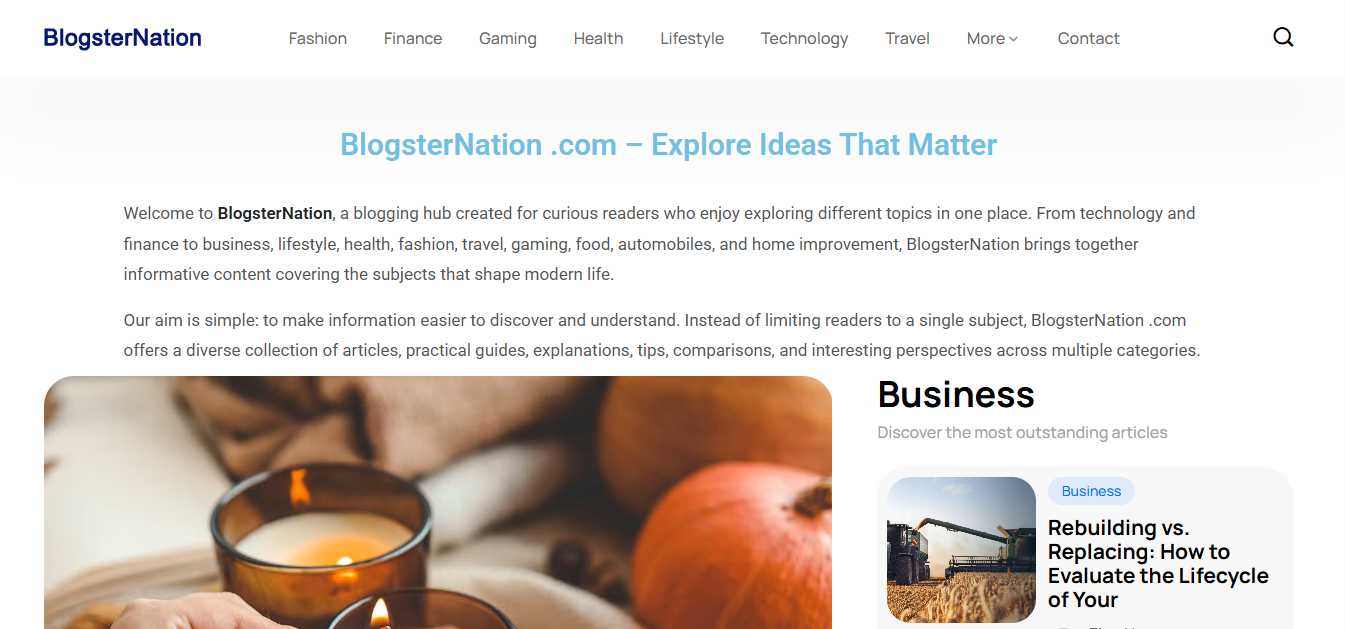
BlogsterNation.com is a multi-topic digital publication that publishes informational articles, explanatory guides, comparisons, and practical advice. Rather than concentrating on one industry, it covers subjects that touch different parts of everyday life.
The website’s range includes:
- Technology: Software, digital platforms, online tools, and technology developments.
- Business: Entrepreneurship, workplace issues, industries, and business decisions.
- Finance: Money-related concepts and financial information.
- Lifestyle: Everyday interests, relationships, and modern living.
- Health: General wellness and health-related information.
- Travel: Destinations, trip planning, and travel advice.
- Fashion: Clothing, personal style, beauty, and accessories.
- Gaming: Gaming platforms, industry developments, and related topics.
Readers can browse articles by subject instead of limiting themselves to a single area of interest. Someone researching an online business, for instance, might also find articles about digital tools, finance, or marketing useful.
One distinction matters here: a website that publishes blog articles is not necessarily a self-publishing platform. A publication may commission or produce its own articles without offering visitors an account, writing dashboard, or the ability to publish their own posts.
Anyone looking to become a contributor should check BlogsterNation’s current submission policy rather than assume that an article directory or open publishing system is available.
Blog BlueFlamePublishing Posts – Your Complete Guide to Writing, Publishing, and Creative Growth
What Topics Can You Explore on BlogsterNation.com?
The breadth of a publication is useful only when its categories answer real questions. Here is how the website’s subject areas may serve different readers.
Technology and Digital Trends
Technology changes the way people work, shop, communicate, and manage their businesses. Yet technical explanations can become difficult to follow when they assume too much prior knowledge.
Technology articles can help readers understand software, compare digital tools, learn unfamiliar terminology, and investigate developments affecting their work or personal lives.
For a small business owner, a practical guide to choosing software may be more useful than a lengthy discussion of the technology behind it. A student might instead be looking for a plain-language explanation of a new digital concept.
The value of an article depends on whether it answers the question at hand. When researching a product or service, readers should also check the provider’s official documentation, current pricing, compatibility requirements, and limitations.
Business and Entrepreneurship
Business decisions often involve trade-offs rather than simple right-or-wrong answers. Hiring an employee, selecting a supplier, expanding a product range, or entering a new market can each affect costs and future growth.
Business-related articles can give readers a starting point for examining these decisions. They may introduce industry concepts, explain workplace practices, or suggest questions worth asking before committing money or resources.
Entrepreneurs should treat general advice as a starting point for investigation, not a substitute for a plan built around their own customers, finances, and operating conditions.
For example, an article about opening an online store may introduce inventory management, payment processing, customer acquisition, and fulfilment. A prospective store owner would still need to calculate product margins, shipping expenses, advertising costs, and likely demand.
Finance and Money-Related Information
Financial topics deserve more careful reading because an inaccurate assumption can have direct consequences for a person’s money.
Articles in this category may help readers become familiar with financial terminology, understand how different financial products work, or identify questions to investigate before making a decision.
A sensible reader should distinguish between an educational explanation and a recommendation to buy, sell, borrow, or invest.
Before acting on financial information, check the publication date, confirm figures against current official sources, and consider whether the guidance applies to your country and circumstances. Investment decisions, tax obligations, loan terms, and financial regulations can differ considerably between jurisdictions.
Lifestyle, Health, and Home Improvement
Everyday questions often lead people to seek straightforward advice rather than specialist terminology. Lifestyle content can address subjects such as relationships, household routines, personal interests, and practical changes at home.
Home improvement articles may help readers compare options before buying materials or hiring a contractor. Lifestyle guides can offer ideas that readers adapt to their own circumstances.
Health information requires a higher standard of scrutiny. General wellness articles can introduce a subject, but they should not replace a qualified healthcare professional’s assessment, particularly when symptoms are persistent, treatment is involved, or a decision could affect someone’s safety.
Readers should look for credible sources and relevant professional qualifications whenever an article makes medical claims.
Travel, Fashion, and Entertainment
Travel guides can help people research destinations, understand trip-planning considerations, and prepare questions before making reservations. Because travel costs, entry requirements, transport arrangements, and local conditions change, older articles may need to be checked against current official information.
Fashion content serves a different purpose. Readers might look for clothing ideas, styling advice, or explanations of trends. The most useful guidance accounts for factors such as fit, climate, budget, and the occasion rather than assuming every trend suits every person.
Entertainment and gaming articles can help readers explore interests, learn about platforms, or follow developments in their preferred activities.
Across these subjects, the same principle applies: an article is a useful starting point when it gives the reader enough context to decide what to investigate next.
The A-to-Z Guide on Getting Mind-Blowing Guest Blogging Success
Key Features of BlogsterNation.com
BlogsterNation presents itself as a publication designed around accessible information and topic-based discovery. Its website describes an editorial approach that emphasizes reader needs, research, clear explanations, and reviewing content when information changes. These are stated editorial principles; readers should still judge each article on its own merits.
Topic-Based Navigation
Organizing articles by subject helps visitors move from a broad interest to a more specific question. Someone interested in business can browse related material without first working out which section of a general news website might contain it.
Category pages are most useful when their labels are clear and their articles genuinely relate to the subject. Readers can usually get more from browsing when they have a particular question in mind rather than opening articles at random.
Informational Articles and Practical Guides
Different questions require different formats. A short explanation may be enough to define a term, while a buying decision may require a detailed comparison, evidence, and a discussion of disadvantages.
BlogsterNation publishes a mixture of informational content and practical guides. The important question is whether a particular article gives enough detail to support the task it claims to address.
A useful guide should explain its reasoning, identify relevant limitations, and distinguish facts from opinions. A list of suggestions without explanations may provide ideas, but it should not be mistaken for a thorough evaluation.
Readable Article Structure
Headings, concise paragraphs, and descriptive subheadings make long articles easier to navigate. Readers should be able to locate the section relevant to their question without having to read every sentence in order.
Clear formatting, however, is not proof of accuracy. A polished article can still contain outdated figures, unsupported claims, or incomplete explanations. Presentation and factual reliability need to be assessed separately.
Editorial Information
BlogsterNation’s About Us page describes its editorial principles and identifies Elen Havens as its editor.
That information gives visitors some context about the publication’s stated approach. For a more complete assessment, readers should also inspect the byline, references, author qualifications, publication date, and any disclosures attached to the individual article they intend to use.
These details matter particularly when the subject involves health, money, legal obligations, or expensive purchases.
Content Updates
Information can lose its value when circumstances change. A guide to software may become inaccurate after an interface redesign, while a finance article may refer to rates or rules that no longer apply.
BlogsterNation says it reviews existing material when important information changes. Readers should still check the date and verify time-sensitive claims independently, especially when the article does not clearly identify when its facts were last checked.
How Can BlogsterNation.com Help Readers?
The most useful way to approach a multi-topic publication is to begin with a specific question. The website then becomes a place to investigate that question, rather than simply another destination for casual browsing.
Finding Information Across Different Subjects
Some questions cross the boundaries between conventional categories. A freelancer considering a new business may need information about software, pricing, budgeting, and customer acquisition.
A multi-topic publication gives that reader an opportunity to explore related subjects in one place. The advantage is convenience, although the reader may still need specialist publications for deeper research.
Learning About an Unfamiliar Subject
Not everyone begins with the vocabulary needed to research a complicated topic. An introductory article can explain basic terminology and point readers toward the issues that matter most.
Suppose someone wants to understand website analytics. A well-prepared introductory guide might explain visitors, traffic sources, conversion rates, and engagement before moving into more advanced measurement questions.
That initial understanding makes subsequent research easier. The reader can then consult product documentation, original research, or specialist advice with a clearer idea of what to look for.
Comparing Options Before Making a Decision
Informational articles can help readers build a shortlist, identify selection criteria, and spot potential drawbacks.
Someone comparing business software, for example, might use an introductory guide to identify the features they need. The next step would be to compare current prices, trial restrictions, integrations, customer support, and cancellation terms directly with the vendors.
This distinction is important: reading about an option is not the same as verifying that it is the right option for you.
Saving Time Without Skipping Research
A well-organized guide can reduce the time spent understanding a subject from scratch. It cannot eliminate the need to check original sources when the decision carries significant consequences.
Use general articles to establish context, then move to authoritative material for details that must be correct. This approach helps readers avoid both extremes: accepting the first explanation they find and spending hours researching basic concepts that could have been explained more simply.
Is BlogsterNation.com Useful for Bloggers and Content Creators?
Bloggers can use multi-topic publications as research destinations, but the benefits depend on how they use the material and whether the website offers opportunities to contribute.
Use Articles to Identify Reader Questions
Existing articles can reveal how a subject is explained to a general audience. A writer researching small-business finance, for instance, can examine the questions an introductory guide answers and identify areas that require further explanation.
The goal should not be to reproduce another article’s structure or wording. Instead, look for questions that remain unanswered, assumptions that need testing, and practical examples that would help readers understand the subject more fully.
Verify Facts Before Using Them
An article can point a writer toward an interesting idea, but important claims should be traced to their original sources.
Useful sources include government publications, company documentation, published research, industry data, and interviews with qualified specialists. Checking these materials helps writers avoid repeating errors that may have appeared across several websites.
Where an article offers no references for a significant claim, treat that claim as something to investigate rather than an established fact.
Check Whether Contributor Opportunities Exist
Writers who want to publish their work should look for an official contributor policy, submission guidelines, or editorial contact details.
Before submitting an article, establish whether the publication accepts unsolicited work, whether there are fees, who retains copyright, whether links are permitted, and whether the publisher can edit or republish the material.
Do not assume BlogsterNation offers open submissions, author accounts, or paid writing opportunities unless its current policies confirm them.
BlogsterNation.com and SEO: What Should Website Owners Know?
Search engine optimization is relevant to multi-topic publications because readers often arrive while looking for answers to specific questions. However, the presence of articles on a website does not automatically make that website valuable for SEO.
Content Organization and Discoverability
A logical category structure helps readers understand where information belongs and how related articles connect.
For website owners, useful organizational practices include:
- Assigning each article to a relevant category.
- Using descriptive headings that reflect the subject.
- Linking to related pages when they provide additional value.
- Avoiding unnecessary duplication between articles.
- Keeping navigation understandable as the publication grows.
These practices support usability and help search engines interpret a website’s content. They cannot guarantee that a page will be indexed or rank well.
Content Quality Matters More Than Article Volume
Publishing more pages does not necessarily produce more useful search traffic. A large collection of articles that repeat familiar information may do little for readers who need accurate answers or practical guidance.
Writers should ask three questions before publishing:
- Does the article answer the question implied by its title?
- Does it offer evidence, examples, or explanations that justify its recommendations?
- Can a reader make a better-informed decision after reading it?
Original research, first-hand experience, expert input, and carefully checked examples can give an article value beyond a summary of existing search results.
Can Publishing on BlogsterNation.com Improve Your SEO?
There is no sound basis for promising a ranking improvement simply because an article appears on a particular publication.
If a website accepts contributions, the SEO value of a placement depends on several factors, including whether the page reaches a relevant audience, whether the content is genuinely useful, and whether any resulting link is editorially appropriate.
A backlink is not automatically valuable because it comes from a published article. Links purchased primarily to manipulate rankings, or obtained through scaled low-quality guest posting, can create search-policy risks. Paid placements should be disclosed appropriately and handled in accordance with Google’s link-spam policies.
For businesses, the better objective is to reach relevant readers and earn legitimate recognition. Search rankings should not be the sole measure of a publication’s value.
BlogsterNation.com vs. Other Blogging and Publishing Platforms
BlogsterNation is best understood as a multi-topic publication. That differs from services designed primarily to help individuals create and manage their own blogs.
| Platform | Main purpose | Who may find it useful |
|---|---|---|
| WordPress | Website and blog creation | Businesses, publishers, and independent bloggers who want control over their websites |
| Medium | Publishing articles and reaching readers through a writing community | Writers who want to publish essays and other long-form work |
| Blogger | Hosted blog creation | Beginners who want a straightforward blogging service |
| BlogsterNation.com | Reading articles across multiple subject areas | Readers looking for information on a variety of topics |
WordPress: For Building Your Own Website
WordPress is worth considering when ownership and control are priorities. Depending on the version and hosting arrangement, users can build websites, manage content, customize their design, and add functionality.
That flexibility comes with decisions about setup, maintenance, hosting, and security. It serves a different purpose from visiting an established publication to read an article.
Medium: For Publishing and Discovering Articles
Medium provides a publishing environment for writers who want to share essays, commentary, and other articles with readers.
It may suit people who prefer to concentrate on writing rather than maintaining a separate website. Writers should review the platform’s current terms and distribution options before deciding whether it fits their publishing goals.
Blogger: For Straightforward Blog Creation
Blogger is a hosted blogging service suited to people who want to start publishing without managing every aspect of website infrastructure.
It is worth considering for a personal blog or a simple publication. Its suitability depends on the owner’s requirements for design, functionality, growth, and control.
Where Does BlogsterNation.com Fit?
BlogsterNation’s main appeal is its collection of articles across different subjects. It is therefore more appropriate to compare it with other informational publications when the question is where to read, rather than where to build, a blog.
If your objective is to publish your own work, confirm whether the site provides a submission route before treating it as an alternative to a dedicated blogging service.
Advantages and Limitations of BlogsterNation.com
A fair assessment should consider both what a multi-topic publication makes easier and where readers may need additional resources.
Potential Advantages
A broad range of subjects. Readers can explore technology, business, finance, lifestyle, and other interests without committing to a single specialist topic.
A starting point for research. Introductory articles may help readers understand unfamiliar terminology and identify questions worth investigating.
Convenient topic discovery. Category-based browsing can make it easier to find related material when a reader is exploring a new subject.
A stated focus on readability. BlogsterNation describes an editorial approach centered on clear explanations and reader needs. Individual articles should still be evaluated independently.
Limitations to Keep in Mind
Coverage may vary in depth. A general publication cannot be expected to provide specialist-level treatment of every subject it covers.
Accuracy needs to be checked. An article’s presence on a professional-looking website does not establish that every claim is correct.
Some information becomes outdated quickly. Financial rules, product features, prices, travel requirements, and technology instructions may change.
Publishing opportunities are a separate question. A website that publishes blog posts does not necessarily accept submissions from outside writers.
Different subjects require different evidence. A lifestyle opinion piece and a medical explainer should not be judged by identical standards. The latter requires stronger sourcing and appropriate expertise.
These limitations do not make a multi-topic publication inherently unhelpful. They simply establish how readers should use it: as a source of information whose usefulness depends on the quality and relevance of the individual article.
How to Evaluate Information Published on BlogsterNation.com
Before relying on an article, spend a little time checking the information behind it. This is particularly important if you intend to spend money, change a business process, or make a decision affecting your health or legal position.
1. Check the Author and Their Expertise
Look for an author biography and determine whether the person has relevant experience with the subject. A byline is useful, but the author’s qualifications and experience should match the claims being made.
For technical or specialist topics, relevant professional credentials can help readers judge the author’s authority.
2. Look for Sources and Supporting Evidence
Specific claims should have a reasonable basis. Depending on the topic, that may mean official statistics, research papers, product documentation, legal texts, or named expert sources.
Be cautious when an article makes precise claims but offers no way to check them.
3. Check the Publication Date
An article written several years ago may still explain a basic concept accurately. Its recommendations about prices, software, regulations, or market conditions may no longer apply.
Look for an update date where available, then verify any information that could have changed.
4. Compare Important Claims With Primary Sources
For example, use a government website to verify a regulatory requirement, a manufacturer’s documentation to confirm a product specification, or an original research paper to investigate a scientific finding.
Secondary articles can explain a subject in accessible language, but primary sources are often better for checking the underlying facts.
5. Look for Commercial Disclosures
An article recommending a product or service may have an advertising, affiliate, or sponsorship relationship. That does not automatically make the article unreliable, but readers should be able to understand relevant commercial connections.
Look for disclosures and distinguish independent comparisons from promotional claims.
6. Be Especially Careful With High-Stakes Topics
Health, legal, and financial information can have consequences beyond an incorrect search result. Do not make a major decision solely on the strength of a general blog article.
Use qualified professionals and appropriate official sources when the circumstances call for them.
What Is the Future of Multi-Topic Digital Publications?
The internet has made publishing easier, but it has also increased the amount of material readers must assess. Multi-topic publications will need to give people a reason to choose their articles over the many other explanations available online.
Several developments are likely to influence their direction.
More Attention to Original Information
Readers can already find countless summaries of familiar subjects. Publications that offer first-hand experience, original data, expert interviews, and useful examples have a stronger reason to attract attention.
For business content, this might mean examining a real operational problem rather than repeating a generic list of success tips. For technology, it could involve testing a tool and documenting its limitations.
Better Content Discovery
Clear categories, useful internal links, and sensible navigation can help visitors move from one question to the next without losing their place.
Personalized recommendations may also help readers discover related subjects, although publications should consider privacy and give users a clear experience rather than overwhelming them with recommendations.
More Careful Use of AI
AI-assisted tools can help with research organization, editing, and routine production tasks. They do not remove the need to verify facts, evaluate evidence, or take responsibility for published claims.
The challenge for publishers is to use such tools without filling their websites with repetitive material that offers little beyond existing articles.
Stronger Editorial Accountability
As readers encounter more automatically generated content, visible authorship, accurate references, transparent commercial disclosures, and a reliable correction process can help publications earn trust.
These are possible directions for digital publishing generally, not confirmed future commitments by BlogsterNation.
Frequently Asked Questions About BlogsterNation.com
What is BlogsterNation.com?
BlogsterNation.com is a multi-topic digital publication that features informational articles and practical guides across areas such as technology, business, finance, lifestyle, health, travel, fashion, and gaming.
Is BlogsterNation.com a blogging platform or an informational website?
It presents itself primarily as a publication for readers exploring different subjects. Anyone looking to create an account and publish original posts should check the current website for confirmed contributor or self-publishing options.
What topics are available on BlogsterNation.com?
Its stated categories include technology, business, finance, lifestyle, health, travel, fashion, gaming, and additional subjects such as food, automobiles, and home improvement. The available articles may change over time.
Is BlogsterNation.com free to use?
The website can be visited at blogsternation.com. For specific access restrictions, paid features, or subscription terms, check the current website rather than assume that every service is free.
Is the information on BlogsterNation.com reliable?
Reliability depends on the individual article. Check the author’s relevant expertise, supporting sources, publication date, and commercial disclosures. Verify important claims with authoritative sources, particularly for health, financial, and legal topics.
Can you publish articles on BlogsterNation.com?
Do not assume that the site accepts guest posts or offers open contributor accounts. Consult its current contact information and submission policies to establish whether external writers can contribute and what terms apply.
Final Thoughts on BlogsterNation.com
BlogsterNation.com offers a broad collection of informational content for readers whose interests extend beyond one subject. Its coverage of technology, business, finance, lifestyle, travel, and other areas gives visitors several starting points for exploring questions they may not yet know how to investigate.
The real test, however, is not how many categories a website lists. It is whether an individual article answers the reader’s question, supports its claims, and provides enough context to make the next step clear.
Use BlogsterNation to explore a subject, understand its basic concepts, and identify useful questions. When accuracy matters, check the evidence and consult authoritative sources before acting.
For readers, that is a sensible way to get value from a multi-topic publication. For writers and business owners, it is also a useful reminder: content earns attention when it helps someone understand a problem or make a better-informed decision—not merely because another article has been published.
 About Carson Derrow


