Table of Contents
The Short Answer
Claude AI is built and owned by Anthropic, a privately held company headquartered in San Francisco. Anthropic is not owned by Amazon, Google, Microsoft, or any single tech giant — despite the tens of billions of dollars those companies have poured into it. It was founded by siblings Dario Amodei (CEO) and Daniela Amodei (President), along with five other former OpenAI researchers, and it remains under the operational control of its founding team and board, backed by a unique governance mechanism called the Long-Term Benefit Trust.
That’s the one-sentence version. The fuller picture — who actually holds equity, who has influence, and how the company is structured to resist outside control — is more interesting, and it matters if you’re a developer building on Claude, a business evaluating it as a vendor, or simply someone curious about the company behind one of the world’s leading AI models.
Who Founded Anthropic?
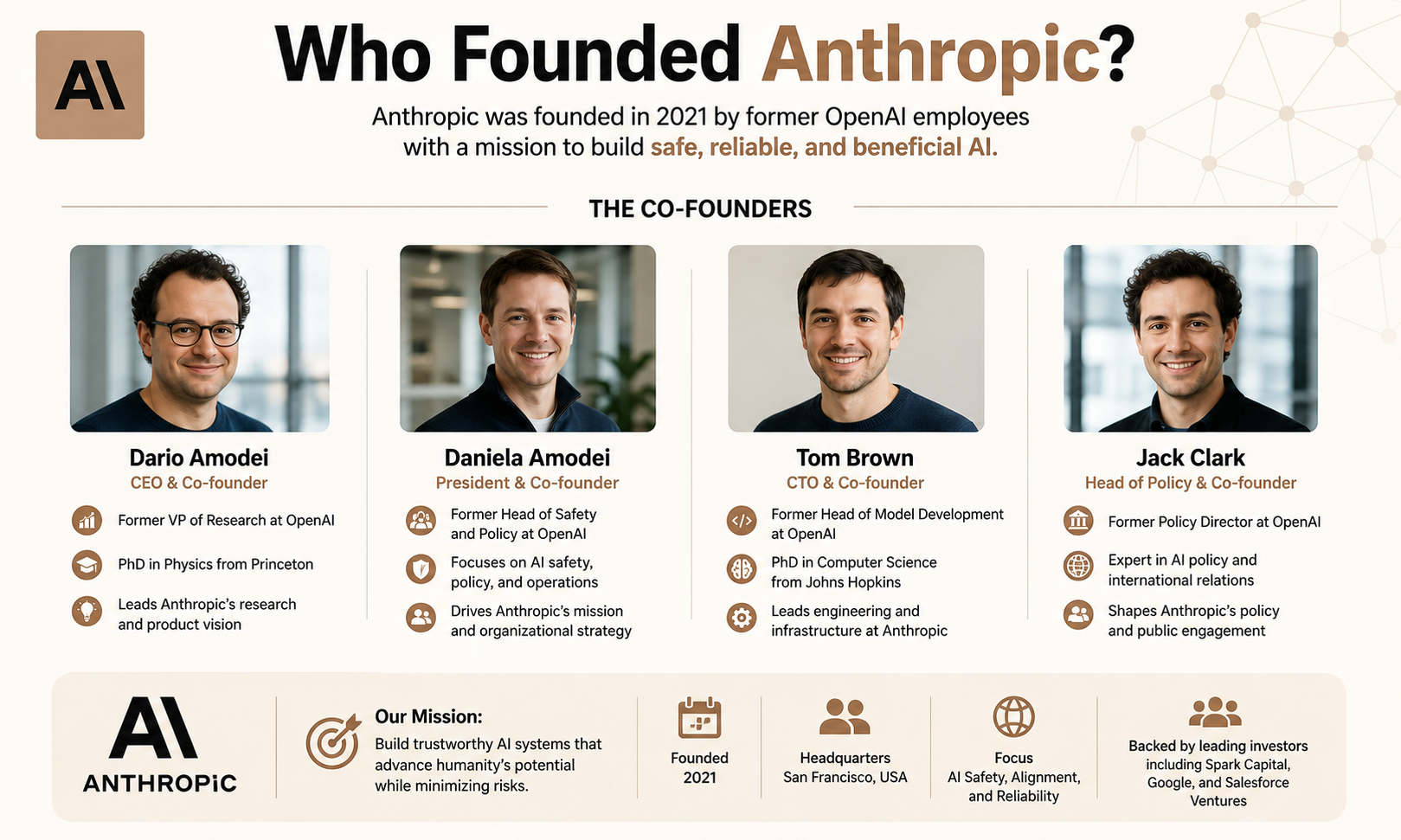
Anthropic was founded in January 2021 by seven former OpenAI employees, most notably Dario Amodei, who had served as OpenAI’s Vice President of Research, and his sister Daniela Amodei, who had led operations there. They were joined by Jared Kaplan, Tom Brown, Chris Olah, Sam McCandlish, and Jack Clark. The founding group left OpenAI reportedly over disagreements about the pace and safety posture of AI development, and set out to build a company that treated safety as a central design constraint rather than an afterthought.
The company raised $124 million in its first funding round in May 2021, and by the summer of 2022 had trained an early version of Claude — but delayed its public release to conduct further internal safety testing, wary of accelerating an AI capabilities race.
The Corporate Structure: Public Benefit Corporation + Long-Term Benefit Trust
Anthropic is organized as a Public Benefit Corporation (PBC), a legal structure (distinct from a nonprofit) that requires the company’s directors to weigh the interests of a stated public mission alongside shareholder returns. In Anthropic’s case, that mission is the responsible development of AI for the long-term benefit of humanity.
Layered on top of the PBC structure is the Long-Term Benefit Trust (LTBT) — an independent body made up of individuals with no financial stake in the company. The Trust holds a special class of shares that gives it the power to select and remove a portion of Anthropic’s board of directors, and that authority is designed to grow over time until the Trust can appoint a majority of board seats. The idea is to create a structural check that prevents any single investor, or the pursuit of profit alone, from steering the company away from its safety mission — even if Anthropic eventually goes public.
This is a deliberate contrast to how some other AI labs are structured, and it’s often cited as one of the more unusual governance experiments in the tech industry.
Who Are the Major Investors?
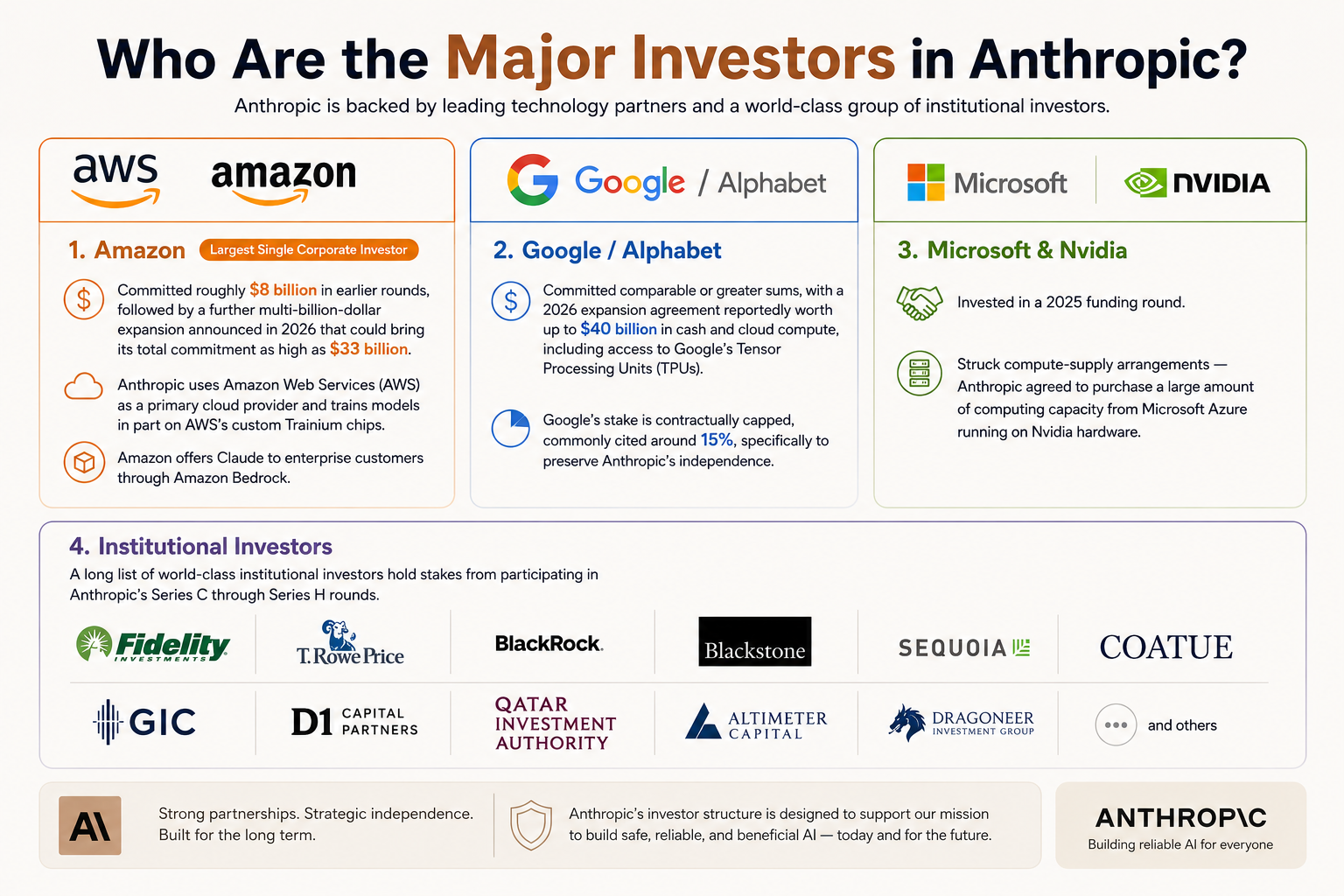
Anthropic has raised well over $100 billion cumulatively across many funding rounds, and its valuation has climbed sharply as investor appetite for frontier AI companies has intensified. Some of the key milestones:
- Amazon is Anthropic’s largest single corporate investor, having committed roughly $8 billion in earlier rounds, followed by a further multi-billion-dollar expansion announced in 2026 that could bring its total commitment as high as $33 billion. In exchange, Anthropic uses Amazon Web Services (AWS) as a primary cloud provider and trains models in part on AWS’s custom Trainium chips, while Amazon offers Claude to enterprise customers through Amazon Bedrock.
- Google / Alphabet has committed comparable or greater sums, with a 2026 expansion agreement reportedly worth up to $40 billion in cash and cloud compute, including access to Google’s Tensor Processing Units (TPUs). Google’s stake is contractually capped, commonly cited around 15%, specifically to preserve Anthropic’s independence.
- Microsoft and Nvidia invested in a 2025 funding round and have struck compute-supply arrangements — Anthropic agreed to purchase a large amount of computing capacity from Microsoft Azure running on Nvidia hardware.
- A long list of institutional investors — including Fidelity, T. Rowe Price, BlackRock, Blackstone, Sequoia Capital, Coatue, GIC, D1 Capital Partners, Qatar Investment Authority, Altimeter Capital, and Dragoneer Investment Group, among others — hold stakes from participating in Anthropic’s Series C through Series H rounds.
By way of a rough timeline: a $30 billion Series G round in February 2026 valued the company at roughly $380 billion; by May 2026, a $65 billion raise involving investors like Sequoia, Altimeter, and Dragoneer pushed the valuation to approximately $965 billion, making Anthropic one of the most valuable privately held companies in the world.
Crucially, none of these investors — not Amazon, not Google, not Microsoft, not the institutional funds — hold board seats tied to their investment or voting control over Anthropic’s strategy. Their leverage comes instead from commercial relationships: cloud hosting agreements, compute supply deals, and distribution partnerships, rather than equity control.
Is Anthropic Going Public?
As of mid-2026, Anthropic remains privately held, though reporting indicates the company has taken steps toward an eventual initial public offering, including a confidential IPO filing. No listing date, stock exchange, or ticker symbol has been confirmed. Anthropic’s leadership has structured the company so that the PBC designation and the Long-Term Benefit Trust would carry over into any future public listing, meaning the safety-oriented governance guardrails are intended to persist even if shares eventually trade on a public exchange.
Until (and unless) that happens, there is no way to buy stock in Anthropic directly. The closest public-market proxies for indirect exposure are shares of Amazon (AMZN) and Alphabet (GOOGL/GOOG), given their large financial stakes in the company.
Who Actually Controls Claude’s Development?
Day-to-day strategic and research direction remains with Anthropic’s leadership team, led by Dario Amodei as CEO and Daniela Amodei as President, alongside the company’s board of directors. Employees also hold meaningful equity through grants, which aligns the people actually building Claude with the company’s long-term independence.
The Long-Term Benefit Trust is the backstop: it doesn’t run daily operations, but it holds the authority to intervene at the board level if the company’s direction were to conflict seriously with its stated safety mission. Critics have noted that this mechanism is relatively untested and its real-world teeth remain to be seen, particularly as commercial pressure mounts ahead of a potential IPO. Supporters argue that simply having such a structure in place — unlike most venture-backed AI companies — creates accountability that wouldn’t otherwise exist.
Why This Matters
A few practical implications follow from this ownership structure:
- Product availability: Because Amazon and Google are investors rather than owners, Claude remains available across multiple cloud platforms (AWS, Google Cloud, Microsoft Azure) rather than being locked into a single ecosystem.
- Continuity: Anthropic’s independence means Claude’s availability and roadmap aren’t directly subject to the whims of any one corporate backer.
- Safety mission: The PBC structure and the Trust are Anthropic’s attempt to ensure that safety research and responsible deployment stay central to decision-making, even as the company scales and takes on enormous sums of investment capital.
- No single owner: Despite the scale of investment from Amazon and Google, Claude is not “an Amazon product” or “a Google product.” Anthropic alone controls Claude’s model weights, training methodology, and commercial terms.
Bottom Line
Claude AI is owned and operated by Anthropic, PBC — a company founded and still led by Dario and Daniela Amodei, financed by a large and growing roster of strategic and institutional investors (most prominently Amazon and Google), but structurally insulated from any single investor’s control through its Public Benefit Corporation status and the Long-Term Benefit Trust. Ownership, in the traditional sense of who holds equity, is spread across founders, employees, and outside investors — but control, in the sense of who sets the company’s direction, still runs through Anthropic’s own leadership and governance structures.
 About Carson Derrow