Startups are exciting and seem fun to start until you really get into the grind of work. This video is a startup owner reflecting on his experiences so far, highlighting what the toughest and most time-consuming aspects of running a new business are.
For a minute, the founders were just responding to emails from customers. The next minute, they’re logged in to several analytics dashboards, SEO, payroll, marketing automation, investor updates and new AI tech that promises to deliver 100x growth. Soon enough, they’re spending all their time just figuring out the best tools to run a startup.
More entrepreneurs are choosing to build on smarter systems rather than just launching another app. As start ups grow, they need a better way to navigate the tools that are already in use.
For a startup, it is crucial to scale up efficiently without burning through too much time, money, or energy. Many tools are available today that can aid in analytics and automation, as well as customer management and collaboration.
This guide will cover some of the most important tools for a startup in 2026, help you choose the right ones, and discuss common mistakes startup founders tend to make. I’ll also outline the future trends in startup development.
Table of Contents
What Are Growth Navigate Startup Tools?
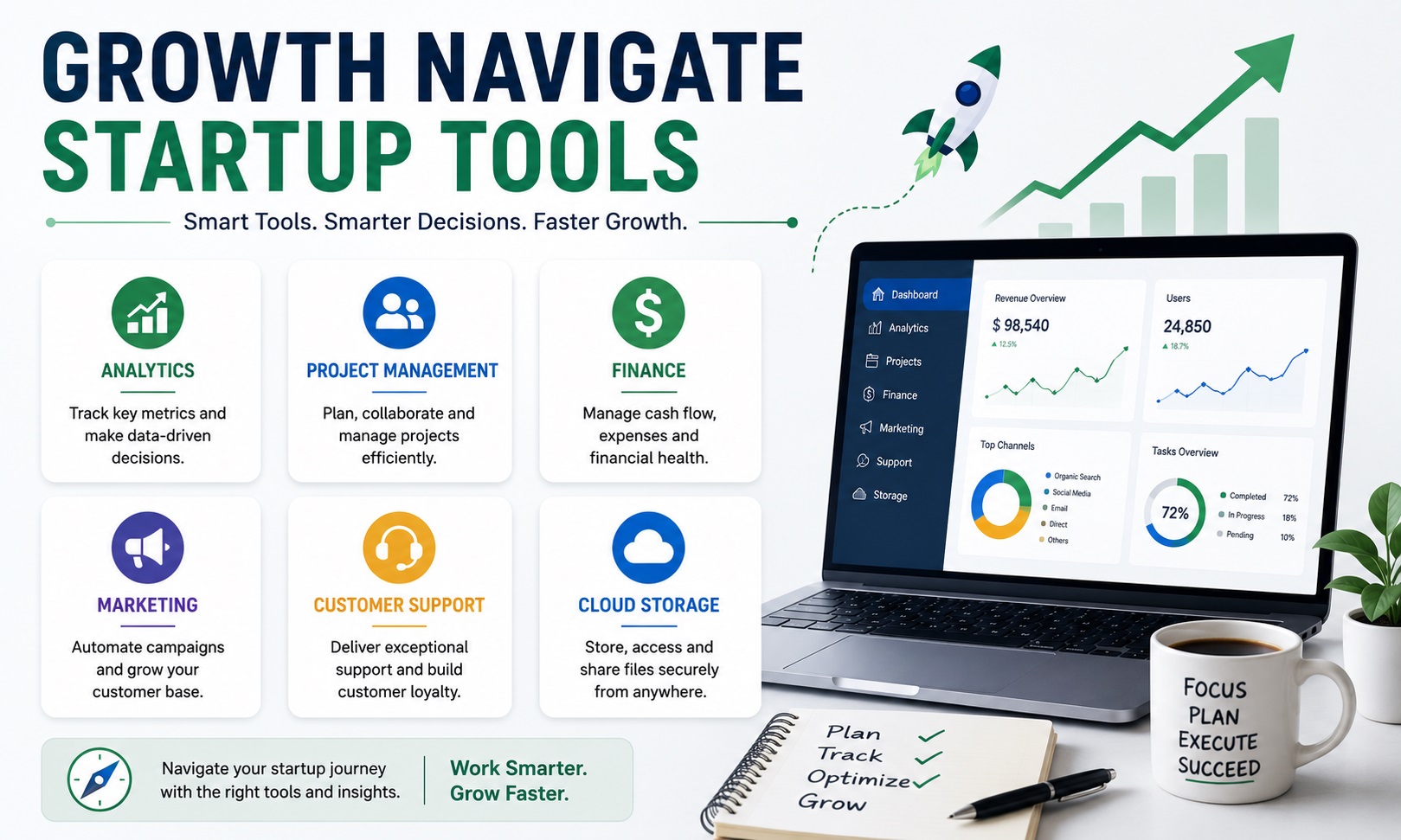
Growth Navigate startup tools are software solutions designed to help startups manage growth more efficiently.
Save yourself the hassle of using spreadsheets and doing work by choosing these tools instead!
- Customer relationship management
- Marketing automation
- Financial tracking
- Team collaboration
- Data analytics
- Workflow automation
- Lead generation
- Project management
The word “navigate” is important here, because moving fast at a startup means nothing if you’re not moving in the right direction.
Why do so many startups fail for the same reasons? It’s because they have scaled too quickly for their systems. Or worse, have created inefficiency and confusion by using unrelated tools spread across too many tabs and applications. Modern startup software helps teams operate off one system of record, with a shared understanding of data and clear decision-making intelligence.
Top 5 Project Management Tools Startups Can Customize in 2025
Why Startup Tools Matter More in 2026
The world has changed dramatically in the past few years, and the startup world is no exception.
Today’s founders deal with:
- Higher competition
- AI-driven markets
- Remote work environments
- Rising customer acquisition costs
- Faster customer expectations
- Tighter funding conditions
Because of this, efficiency is no longer optional.
Startups these days require automation, deep insights gained from AI, and a suite of integrated systems and tools. What used to require the support of an entire department can now be managed by a handful of employees.
With the right tools, a small startup can potentially beat out a larger and more established team using outdated technology.
Core Categories of Growth Navigate Startup Tools
Unlike larger startups, who require the comprehensive suite of 37+ subscriptions, this team gets by with a simple 2 app setup. It’s amazing how much can be accomplished with a few, well-chosen tools.
The most intelligent organizations (especially startups) keep their tech stack lean and mean.
1. CRM and Customer Management Tools
Customers are the foundation of every startup.
The amount of leads that a growing business receives can be impossible to manage manually. Managing leads manually, just isn’t possible as a business grows. Instead, the best solution is to work with a CRM, where leads can be organized, follow-ups automatically scheduled, conversations logged, and customers retained.
Popular CRM tools in 2026 include:
- HubSpot
- Salesforce
- Freshsales
- Keap
- Insightly
More and more CRMs today are incorporating AI elements into their platforms. Using predictive analytics and lead scoring, these systems allow you to maximize your chances of connecting with your best leads.
And when you’re a very early-stage startup, it’s likely that you don’t need the elaborate features offered by most enterprise software.
2. Analytics and Reporting Tools
Growth without data is basically guesswork.
Analytics tools help startups track:
- Website traffic
- Customer behavior
- Conversion rates
- Revenue trends
- Retention rates
- Marketing performance
Important startup metrics include:
- Customer Acquisition Cost (CAC)
- Lifetime Value (LTV)
- Monthly Recurring Revenue (MRR)
- Burn rate
- Churn rate
- Popular analytics platforms include:
- Google Analytics
- Mixpanel
- Hotjar
- Amplitude
These tools are powerful, helpful resources for founders to make informed, timely business decisions.
3. Marketing Automation Tools
Marketing in 2026 is heavily automated.
Instead of building a team of specialist campaign managers to handle leads, startups are turning to software to help automate the early stages of engagement.
- Email marketing
- SEO management
- Lead nurturing
- Social media scheduling
- Customer segmentation
- Personalized outreach
Automation saves time while improving consistency.
If you’re building a startup, you might not know that services like Mailchimp and Email Marketing tools like ActiveCampaign, or even your Marketing/CMS software like HubSpot, allow you build out customer journeys that can be set up to run automatically.
For small teams it can be a huge advantage.
4. Team Collaboration and Project Management Tools
Remote work is no longer novel to the startup; Hybrid models are the new normal.
Teams need a system to keep communication organized as well as a means to keep projects on track.
Popular collaboration tools include:
- Slack
- Notion
- ClickUp
- Trello
- Asana
By shifting to online platforms, your organization can achieve greater accountability, better tracking of tasks, and increased transparency into your workflow.
So consensus on the next steps means execution is much faster.
5. Financial and Budgeting Tools
Another reason Startups die is because of cash flow problems (which is a lot worse than a bad idea).
Knowing financials from day one is crucial.
Modern finance tools help startups monitor:
- Expenses
- Revenue
- Forecasting
- Payroll
- Runway
- Investor reporting
Popular financial tools include:
- QuickBooks
- Xero
- Stripe Dashboard
- Ramp
These tools help you budget and avoid silly mistakes as a startup founder.
Essential Tech Stack for Entrepreneurs: Free Tools to Build and Scale
How to Choose the Right Startup Tools
While it’s common for founders to select tools due to “hipness,” this can ultimately lead to their downfall.
Looks matter, but most important: does it actually solve a problem?
Before adding any software, ask these questions:
Does It Solve an Actual Problem?
Avoid downloading tools “just in case.”
Every platform should improve efficiency or remove friction.
Is It Easy to Use?
This software may be too complicated for our needs at this time as it would require our team to spend weeks training.
Simple tools often work better for startups.
Does It Integrate Well?
Disconnected tools create operational chaos.
A good startup software should integrate with the most common CRM, analytics, marketing and collaboration software.
Can It Scale With Your Business?
Our software has to be relatively stable; changing software every few months can get very expensive and pretty bothersome.
Choose systems that can grow alongside your startup.
Does It Support Automation?
Our startup prediction for 2026: Automation will be the biggest advantage that small businesses have.
We’re seeing more and more workflows leveraging AI to outsource repetitive tasks like reporting, customer support, lead qualification and follow-ups.
Common Mistakes Startups Make
Even the best software won’t fix poor decision-making.
Here are some common startup tool mistakes:
Tool Overload
Many startups install too many apps too early.
This leads to:
- Higher costs
- Confusing workflows
- Duplicate systems
- Team frustration
Keep your code lean and your calls connected.
Ignoring Data
Collecting data means nothing if nobody analyzes it.
Automating Too Early
Automation works best after processes are stable.
Automating messy systems simply creates faster problems.
Choosing Enterprise Tools Too Soon
So many early-stage founders are paying for enterprise-level software that they don’t need.
Start simple and scale gradually.
The Top Digital Tools Every Entrepreneur Needs
AI and the Future of Startup Tools
Artificial intelligence is now built into almost every major startup platform.
Instead of separate AI products, startups now see AI integrated directly into:
- CRM software
- Marketing tools
- Analytics dashboards
- Customer support systems
- Financial forecasting platforms
AI helps startups:
- Predict customer behavior
- Forecast revenue
- Personalize marketing
- Automate support
- Analyze trends faster
Startups that adapt to AI-powered workflows early will likely gain a major competitive advantage in the coming years.
Recommended Startup Tool Stack for 2026
A strong startup stack doesn’t need to be complicated.
| Function | Recommended Tools |
| CRM | HubSpot, Freshsales |
| Analytics | Google Analytics, Mixpanel |
| Collaboration | Slack, Notion |
| Project Management | ClickUp, Trello |
| Marketing Automation | Mailchimp, ActiveCampaign |
| Finance | QuickBooks, Stripe |
| SEO | Ahrefs, Semrush |
| Automation | Zapier, Make |
The goal is not having the most tools.
The goal is having tools that work together smoothly.
Final Thoughts
Starting a new company in 2026 is difficult for founders, but they also have significantly more capabilities at their disposal than founders in the past.
You might think the real hurdle for farmers is tracking down software that will handle their specific needs. But the more pressing issue is frequently how to locate systems that will enhance the way you are already operating, and not add layers of infeasible complexity.
The best growth navigate startup tools. They help startups organize, scale and make data-driven decisions, reducing repetitive tasks, helping you make better decisions and enabling smaller teams to do more with limited resources.
But tools alone won’t guarantee success.
Execution still matters most.
Small, focused startup with orderly workflows and systems beats big, bureaucratic, messy team with every passing day.
 About Carson Derrow

