In 2015, three analysts writing in PLOS Biology finally put a number on something the life science sector had complained about for a decade without measuring. Freedman, Cockburn and Simcoe estimated that roughly USD 28 billion is spent every year in the United States alone on preclinical research that cannot be reproduced, working from a deliberately conservative assumption that half of preclinical output fails replication. The figure traveled widely. The part that should interest anyone who handles a pipette traveled less well.
When the authors broke that spending down by cause, the largest single category was neither experimental design nor statistics. It was biological reagents and reference materials, at roughly 36 percent of the total, ahead of study design at about 28 percent, data analysis and reporting at about 25 percent, and laboratory protocols at about 11 percent. Reagents are not a background line item. They are the best-documented source of wasted preclinical money in the literature.
Among reagents, few are treated as casually as the one that turns a freeze-dried solid back into something measurable. What follows examines that step strictly as a laboratory operation: preparing research-use-only material for benchtop and in vitro analysis.
Table of Contents
A Plain Reagent Inside a Very Large Supply Chain
The commercial signal points in the same direction as the reproducibility literature. Market.us values the global bacteriostatic water market at USD 1.22 billion in 2024 and projects USD 2.61 billion by 2034, a compound annual growth rate of 7.9 percent, with North America holding 41.7 percent of 2024 revenue. Close to 8 percent annual growth is an energetic trajectory for a product that is, chemically, water carrying under one percent of a preservative.
That reagent sits inside a far bigger economy. Precedence Research puts the global life science reagents market at USD 73.06 billion in 2026, up from USD 68.99 billion in 2025, with a forecast of USD 121.76 billion by 2035 at 5.85 percent annual growth. The high-purity solvent segment that feeds analytical laboratories is larger again: BCC Research valued it at USD 32.7 billion in 2025 and projects USD 45 billion by 2030 at 6.6 percent.
Diluents are a rounding error inside those totals, and they sit upstream of almost everything measured downstream. A defect introduced at the moment a lyophilized powder goes into solution does not stay at that step. It propagates into every reading afterward, rarely announcing itself.
What Bacteriostatic Water Actually Is
Benzyl Alcohol and the Precision of the Word Bacteriostatic
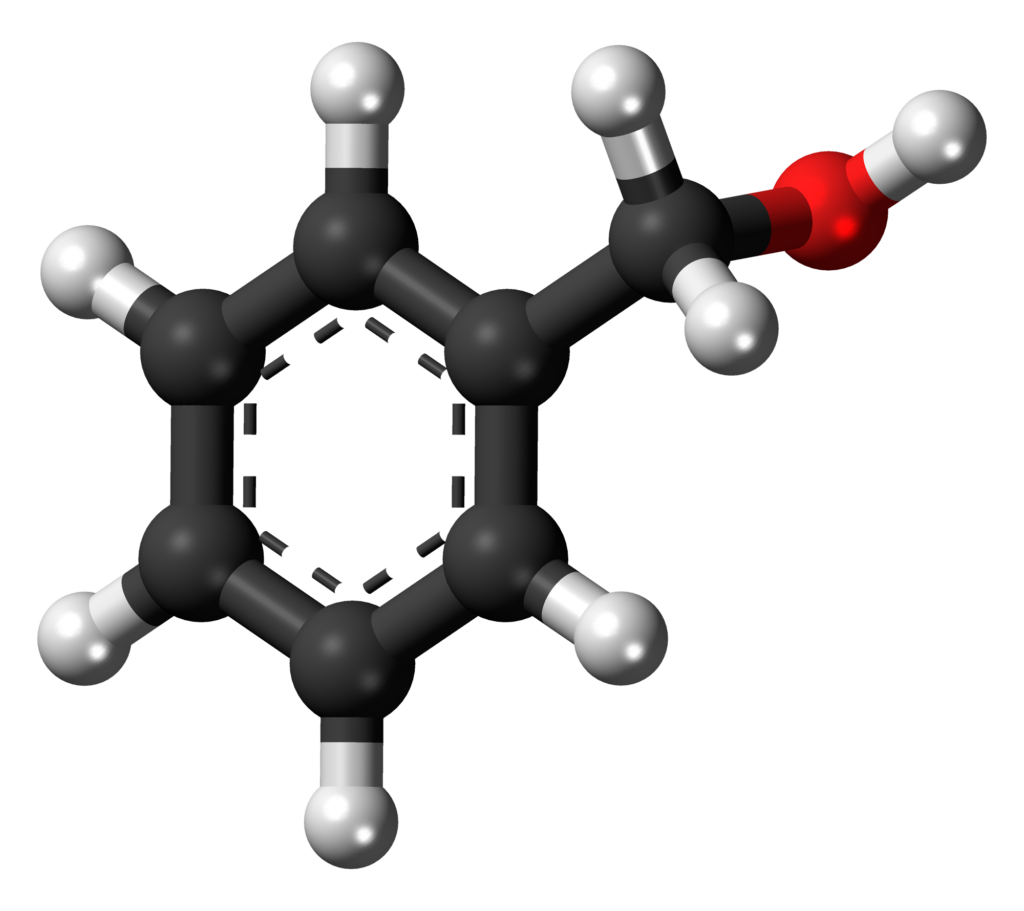
FDA-approved labeling describes the reagent as a sterile, nonpyrogenic preparation of water containing 0.9 percent benzyl alcohol added as a bacteriostatic preservative. Some presentations carry 1.1 percent. Benzyl alcohol is a small aromatic alcohol that partitions readily into lipid membranes, and at preservative concentrations it disturbs bacterial membrane fluidity and permeability enough to suppress replication.
The word bacteriostatic is doing precise work there. A bacteriostatic agent inhibits multiplication of organisms already present or newly introduced; a bactericidal agent kills them. Bacteriostatic water does not sterilize an already compromised solution and does not compensate for careless bench technique. It buys a defined interval against one failure mode, which is the entire scope of its claim.
Grade, pH, and the Compendial Specification
The compendial specification lists a pH of 5.7 with a permitted range of 4.5 to 7.0. Mildly acidic, in other words, and that value is not cosmetic. It sets the ionization state a peptide encounters the instant it enters solution, which in turn governs whether the material dissolves cleanly or clouds. The comparator grade, Sterile Water for Injection, USP, carries no additive at all and sits near neutral. Both are compendial product designations; in the context discussed here they function purely as benchtop reagents.
Grade carries quieter attributes that never surface in a protocol until they fail. Nonpyrogenic status means controlled endotoxin burden; USP designation means a documented purity profile rather than an assumed one. Deionized or distilled water from a benchtop unit meets neither, which is why reconstitution guidance rules it out.
Osmolality is frequently misunderstood here. Unbuffered water contributes essentially nothing to osmolar concentration or ionic strength on its own; whatever tonicity a prepared sample ends up with comes from the material dissolved into it and any buffer added afterward. Where a method requires defined ionic strength, phosphate-buffered saline or an acetate buffer does work that plain water, preserved or not, cannot.
Why Repeat Vial Access Changes the Arithmetic
The labeling describes a container from which repeated withdrawals may be made, and that design feature explains most of the reagent’s appeal in research settings. A sample prepared for one reading on one afternoon does not need a preservative. A sample that has to survive a week of sequential measurements, with the septum entered each time, meets a fresh contamination opportunity on every access.
The consequence shows up in working windows. Reconstitution guidance across the sector converges on a short usable life for non-preserved aqueous preparations, measured in hours to a few days, against a bench window of several weeks at 2 to 8C for preserved ones, with a 28-day convention widely applied to opened preserved vials. Those are handling conventions rather than universal constants, and they hold only alongside temperature control, container integrity, and honest dating.
Diluent Choice as a Variable in Peptide Stability
Charge, pH, and Solubility
Solubility is a function of sequence. A peptide rich in basic residues such as arginine and lysine dissolves readily in slightly acidic water, where those side chains stay protonated and mutual electrostatic repulsion keeps chains from associating. A sequence dominated by aspartate and glutamate behaves the opposite way and prefers mildly basic conditions. The trouble zone is the isoelectric point, where net charge approaches zero, repulsion collapses, and aggregation followed by visible precipitation becomes likely.
Bacteriostatic water’s mildly acidic pH is therefore convenient for many basic sequences and unhelpful for others. Treating one diluent as universally appropriate is where a handling habit stops being a protocol.
When Water Alone Will Not Dissolve the Material
Reconstitution guidance offers a graded escalation. Dilute acetic acid, commonly around 0.1 percent v/v, sharpens dissolution for basic sequences by holding pH low. Dilute ammonium hydroxide or an ammonium bicarbonate solution does the equivalent job for acidic ones. Strongly hydrophobic sequences, and those with enough secondary structure to resist aqueous solvation, may only go into solution in DMSO, with acetonitrile appearing in chromatographic workflows.
Every one of those carries a cost. DMSO is cytotoxic above low percentages in cell-based work, interferes with several readouts, and slowly oxidizes methionine and cysteine on standing. The standard mitigation is to dissolve in the smallest workable volume of the strongest compatible solvent, then dilute into the aqueous working buffer, keeping the organic fraction low enough that it does not become an experimental variable in its own right.
Degradation the Preservative Does Not Touch
A bacteriostatic additive addresses microbial proliferation and nothing else. The chemistry that erodes a prepared sample runs on entirely separate tracks: deamidation at asparagine and glutamine, oxidation of methionine and tryptophan, hydrolysis at labile bonds, disulfide scrambling in cysteine-containing sequences, aggregation driven by hydrophobic patches, and adsorption of dilute material onto glass and untreated plastic surfaces.
Storage discipline therefore matters as much as the diluent: aliquoting to avoid freeze-thaw cycles, -20C for medium-term holds and -80C for longer ones, protection from light, low-binding tubes for dilute preparations, and gentle swirling rather than vortexing to limit shear stress and foaming. A preserved diluent buys time against bacteria. It buys nothing against chemistry.
Where Solvent Selection Becomes a Reproducibility Problem
Interference at the Analytical Bench
Benzyl alcohol is not inert with respect to every readout. It is an aromatic compound with real UV absorbance, which matters in spectroscopic quantification and in chromatographic separations where it can appear as an unexpected peak. In cell-based assays, alcohol carryover at higher solvent fractions can register as a cytotoxic signal that belongs to the diluent rather than to the material under study. ELISA and binding assays have their own tolerance thresholds.
Two laboratories running a nominally identical protocol with different reconstitution solvents will not share a baseline. Neither has made an error in the ordinary sense. They have failed to control a variable the methods section never named, which is exactly the mechanism the reproducibility literature keeps describing.
The Record That Travels With the Sample
Laboratory guidance on preparation records is unusually specific about what belongs in one: material name, lot number, date, preparer, solvent and grade, the weighed quantity used, final volume, calculated concentration, storage location, permitted hold time, and any deviation from the written method. A prepared sample carrying that history is auditable weeks later and reproducible by a second researcher. One without it can be approximated and not repeated.
Solvent identity belongs on that record as a named grade, not a category. “Water” is not a specification. Whether the diluent was preserved, at what benzyl alcohol concentration, at what pH, and from which lot are what let a colleague rebuild a preparation instead of guessing at it.
How This Works in Practice
Preparation standards become tangible where research material is sourced, labeled, and documented, because that is where the variables a laboratory cannot control get fixed for it. A Certificate of Analysis carrying HPLC purity and molecular weight confirmation, an unambiguous lot number, and clear research-use-only designation gives a researcher a defined starting point. Ambiguous incoming material pushes that uncertainty onto the bench, where it costs more to resolve.
US-based suppliers to the research market occupy that position, and Bluum is one of them, listing laboratory peptides on a strictly research-use, not-for-human-consumption basis. What is relevant to this discussion is not any individual catalog entry but the paperwork discipline around it. Consistent identity, consistent lot documentation, and consistent labeling conventions from one order to the next are what allow a laboratory’s reconstitution protocol to have a stable reference point rather than a moving one.
A protocol specifying a diluent, a target concentration, and a storage window is only as reliable as the material entering it. When the incoming compound is characterized and its designation explicit, a researcher can hold the known variables steady and vary only the one under study. That is the purpose of a preparation standard, and it fails at the first ambiguous label.
Where the Category Goes Next
Volume is rising underneath all of this. Mordor Intelligence sizes the peptide synthesis market at USD 1.9 billion in 2026 and projects USD 2.59 billion by 2031, a 6.39 percent compound annual growth rate. More suppliers, more compounds, and more laboratories translate directly into more reconstitution events, each one a point where a standard is either applied or quietly skipped.
The ambient contamination baseline gives a sense of what gets skipped. Screening of cell culture collections has produced estimates that 15 to 35 percent of cell lines carry mycoplasma. An FDA survey found 15 percent of more than 20,000 cultures contaminated. A Netherlands survey found above 25 percent of 1,949 cultures affected, and Germany’s DSMZ reported 31 percent of 598 leukemia-lymphoma lines contaminated. None of those numbers is about peptides; all describe the ambient handling risk preparation standards exist to contain.
Researchers are candid about the outcome. In Monya Baker’s 2016 Nature survey of 1,576 scientists, more than 70 percent reported having failed to reproduce another scientist’s experiment and more than half had failed to reproduce one of their own. Fifty-two percent said the field faces a significant reproducibility crisis, and around 90 percent acknowledged at least a slight one.
The friction ahead is unglamorous. Methods sections still routinely name a solvent without naming its grade, its preservative content, or its lot, and analysts repeatedly flag raw-material availability and tightening regulatory requirements as defining pressures on the sector. A field growing at high single digits every year cannot run quality control on institutional memory.
The Diluent Is Not a Detail
The reconstitution step is the hinge between a compound that exists as a freeze-dried powder and a measurement someone is prepared to defend. Solvent identity and grade, pH and charge compatibility, contamination control, accurate concentration, honest dating, and a complete preparation record are not six separate courtesies. They are one practice, and the economics show what happens when a strand of it is dropped.
None of this requires new instrumentation or a change in methodology. It requires naming the diluent properly, matching it to the chemistry of the material rather than to habit, recognizing that a preservative addresses exactly one failure mode, and writing down what was actually done. Laboratories that treat the humble diluent and the record traveling with it as seriously as the compound itself produce results that survive scrutiny. The rest keep generating data that nobody, including the original author, can repeat.
Research use only. All compounds and reagents discussed here are laboratory materials intended exclusively for in vitro research and analytical use by qualified personnel. They are not drugs, foods, cosmetics, or medical devices, and are not intended for human or veterinary use, diagnosis, or treatment. Nothing above constitutes medical or therapeutic advice, and readers should follow their own institutional procedures and applicable regulations