Years passed before firms realized their mistake. Tools alone did not deliver change. Skilled coders were hired. Algorithms got installed. Still, progress stalled. The problem hid elsewhere. Weak systems of oversight blocked results. The machines worked fine. People failed to guide them. Success needed rules, not just code. Without clear direction, even smart tech fell short.
Surprisingly, leadership teams everywhere now see AI change less about tools. Not software guides outcomes – structures do. What shapes up when systems grow? Oversight steps in. Ethics show up only if rules hold them there. Value does not appear on its own. Security depends more on design than invention. Scalability rises where policies already stand strong.
Some companies pour money into artificial intelligence, automated tools, or new content-generating software. Still, confusion around who is responsible pops up often alongside legal worries, messy information, scattered tests, or workers pushing back.
One study after another points to governance shaping how well AI changes take hold across companies. When it comes to growing AI the right way, specialists say clear responsibility matters – so do systems that manage danger, show inner workings, keep watch. What holds things together often lies in who answers for what goes wrong.
Table of Contents
Why AI Transformation Fails Without Governance
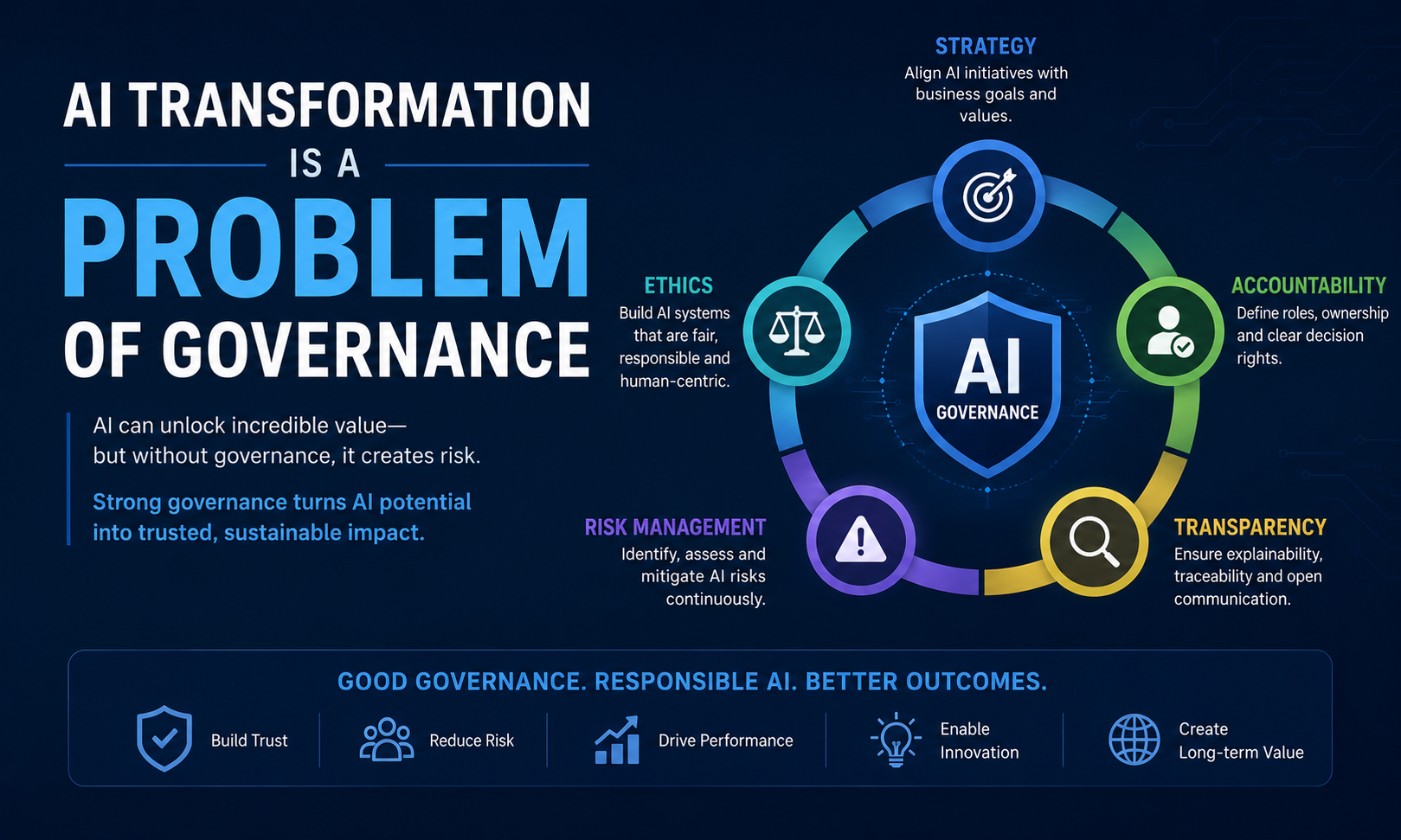
Most of the time, artificial intelligence systems do not break down from faulty code. Trouble usually begins when teams get tangled in messy planning, unclear roles, or shifting goals.
One day, a business starts using artificial intelligence in every area, yet nobody agrees on how it should work. While marketing picks a certain system, human resources goes for a separate option, meanwhile operations settle on a third choice altogether. Before long, mismatched ways of handling information appear everywhere, safety questions come up, money gets spent twice on similar tech, plus confusion grows about which rules apply.
Here’s when things start needing clear rules. Governance steps in once confusion could take hold.
When these setups aren’t there, companies usually face situations like:
- Unclear accountability
- Biased or unreliable outputs
- Regulatory exposure
- Poor employee trust
- Security vulnerabilities
- Wasted AI investments
- Fragmented workflows
Surprisingly few businesses see it coming – strong oversight actually fuels lasting creativity. Not every rule is a roadblock; some clear boundaries help teams sprint further. Without structure, speed becomes chaos. Think of guardrails on a highway at night.
AI vs AGI vs ASI: The Future of Artificial Intelligence in 2026
AI Is No Longer Just an IT Project
What makes governance key? AI touches nearly all parts of how companies run today.
Out of nowhere, artificial intelligence steps into hiring choices, touches how customers feel, guides predictions in finance, strengthens digital defenses, shifts advertising strategies, and moves through logistics networks. Often enough, these smart systems quietly steer company results along with people’s confidence.
Now anyone can see how AI makes choices, not just tech experts.
From top leadership down to daily operations, every layer of a company must step in. When it comes to AI change, working together across teams beats siloed tech trials.
More often these days, those who study industries say handling AI comes down to leading people well – less about coding tools. What matters most shows up in decisions made at the top, not inside tech manuals.
The Role of Data Governance in Artificial Intelligence Outcomes
Built on shaky information, AI falters just like any tool fed poor inputs.
Wrong data leads to flawed forecasts, skewed advice, one wrong step after another in automated tasks. When companies ignore how they handle information, high-end AI systems start breaking down.
Because of this, clear rules for handling information anchor every shift toward artificial intelligence.
Strong data governance helps organizations:
- Maintain data accuracy
- Protect sensitive information
- Ensure regulatory compliance
- Track data lineage
- Improve transparency
- Reduce bias in AI outputs
Research into how companies manage artificial intelligence shows that those using clear rules for handling data tend to adopt AI at larger scales. Not every firm sees results like these when they skip structure around information flow. Rules help keep things running smoothly across departments where machine learning tools get used. Without consistent oversight of datasets, expansion often stalls even if early tests work well. Failing to act leaves firms open to leaks, legal trouble, one misstep away from lost trust.
Artificial Intelligence: Changing How We Work and Play
Governance Builds Trust in AI
People hesitate to embrace artificial intelligence because they do not feel sure about it.
It’s common for workers to feel uneasy when AI feels like a black box – unfair, maybe even built to push people out of the loop. Automated tools can seem questionable from a customer’s view too – are they safe, do they follow moral lines? When it comes to oversight, authorities insist on clear explanations behind every machine-made call.
How things are run tackles those issues head on.
A Well Governed Ai Environment Includes:
- Clear ethical standards
- Human oversight
- Explainable decision-making
- Regular audits
- Bias monitoring
- Accountability structures
Trust comes easier when tools aren’t hidden behind mystery. Systems behave better if boundaries shape their design. Clarity grows where rules guide decisions.
Now more than ever, those who know the field stress clear rules when it comes to artificial intelligence systems. What matters most? Being open about how decisions are made, while also owning up to outcomes – this shapes today’s approach to oversight. Behind every framework popping up lately sits a demand for honesty and responsibility.
Leadership and Accountability Over Tools
Success in AI change often gets tied to picking the top platform, but that belief misses the real picture. Most overlook how much it relies on fit, not features. What matters grows clear only after trying, adjusting, learning. Tools adapt to teams, not just the reverse. Outcomes twist around people more than software. Real progress hides in usage patterns, not vendor promises.
Truth is, how leaders sync up usually counts for more.
Most groups jump straight into using AI before figuring out who’s really in charge. Approval of AI systems lands where? Oversight for potential dangers falls to whom? Ethical questions – someone has to sort those. There comes a point where machines take over too much; knowing when that happens depends on someone making it clear.
Left hanging, those unanswered questions make AI efforts split apart – hard to grow. A single misstep here leads to tangled results down the line. Efforts scatter like loose pages in wind. Without clarity, expansion stalls almost instantly. Each piece operates on its own rhythm, refusing to align. Growth? Not likely when foundations wobble. Pieces never quite fit when direction lacks.
Most well-run companies set up special review panels when handling AI work. Instead of moving fast alone, people from tech, daily operations, law, and top leadership share control – making sure decisions stay grounded.
Long-term goals shape how AI choices are made, because structure guides what machines learn. Business aims come before trial runs when oversight leads the way.
AI Agents: The Future Behind the Code
Regulatory Pressure Grows Quickly
Now that fresh rules around AI are rolling out, how things get managed matters more than before.
Across the globe, rules about privacy, fairness, openness, digital safety, and machine-driven choices keep shifting. Later on, companies brushing off oversight could meet serious legal trouble or steep costs.
A good example? The EU AI Act now demands tighter rules for risky AI tech. Not waiting until laws hit – smart companies are building oversight structures early, specialists say.
Early moves on governance help companies shift more easily when rules change. What comes first often shapes what follows. Staying ahead means less catching up later. Rules keep moving; readiness keeps pace. Those who act before they must usually find their footing quicker.
The Rise of Agentic AI Increases the Importance of Governance
Out of nowhere, today’s AI tools bring tougher questions about control.
Now acting on their own, agentic AI systems go beyond offering suggestions. Triggering workflows is one thing they do without waiting. Pricing adjustments happen automatically, driven by live inputs. Changes to databases occur quietly, often without notice. Decisions get made fast, shaped by rules but rarely touched by people.
Though gains come fast, danger grows just as quick.
Out of control, self-running AI might mess up big time when left unchecked. Watchdogs say companies push powerful artificial intelligence out the door before rules even exist to guide it.
Because of this, putting off governance until later won’t work. Right from the start, it needs to live inside the AI setup.
Building Stronger AI Oversight in Organizations
Clear rules matter more than piles of paperwork. What counts is knowing who answers for what, every single time. Sticking to decisions builds trust far better than red tape ever could.
1. Define Clear Ownership
Someone must answer for how each AI works. Oversight needs clear ownership. Monitoring falls to specific people. Compliance rests in human hands.
2. Create Ethical AI Policies
Fairness must be written down so groups know what counts. Rules about openness keep choices clear for everyone involved. Personal data stays protected when limits are spelled out ahead of time. How smart systems get used comes down to steady habits formed early.
3. Strengthen Data Management
When data rules work well, machines learn better. Security strengthens because information flows make sense. Laws become easier to follow when handling is clear. Precision grows under steady oversight. Order supports smart decisions without surprises.
4. Implement Human Oversight
Still, people must help shape big choices – this matters most where lives change fast, like picking who gets hired, treated, or funded.
5. Monitor AI Continuously
AI systems require ongoing auditing, performance tracking, and bias detection.
6. Match AI to Company Aims
What happens when tech runs ahead of purpose? Projects spin off without direction. Aiming at big goals keeps effort grounded. Focus shifts from novelty to what actually matters. Direction shapes outcomes more than tools ever could.
Governance As True Edge
Success in AI during the coming years won’t favor only those spending the most. Flashy technology alone won’t guarantee results. Some smaller players might outpace giants. Resources matter less than how they’re used. Clever moves could beat heavy investment. What counts is execution, not size. Big names may stumble despite advantages. Quiet progress often wins. Tools fade – strategy lasts longer. Winners adapt fast without noise.
Success belongs to those groups mastering smart control of artificial intelligence.
When AI slips into daily work routines, how it’s managed shapes a company’s ability to grow without risk. Public confidence hangs on oversight that keeps systems accountable. Staying within legal lines depends on clear rules guiding machine decisions. Value shows up only when outcomes can be tracked and proven real.
 About Carson Derrow

