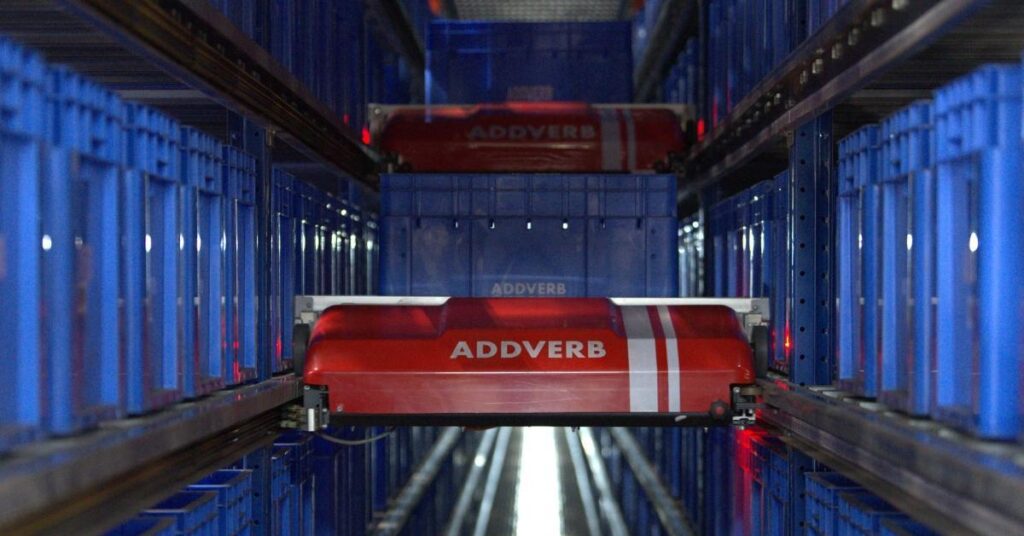
High-volume U.S. distribution centers face a simple problem: more to store, more to move, and less room to add space. As SKU counts and order volumes rise, warehouses need higher throughput, storage density, and faster inventory access. An AS/RS (Automated Storage and Retrieval System) can be a practical solution when the existing setup starts to limit growth.
According to Prologis, only 10–20% of warehouses are expected to be suitable for AS/RS adoption over the next 10–15 years, highlighting why identifying the right operational fit is more important than simply adopting automation.
Fixed automation systems, including AS/RS shuttles, etc., are purpose-built to execute repetitive tasks efficiently within high-volume production environments, making them a fit for distribution centers with predictable order patterns and consistently high throughput. (Source: Addverb – Fixed & Flexible Automation Solutions for the 3PL Industry)
Table of Contents
What Operational Challenges Signal That Manual Storage Has Reached Its Limit?
Manual storage rarely becomes a problem overnight. It starts with longer walks, slower replenishment, and storage locations filling up. As volumes grow, those small delays in a U.S. warehouse can turn into congestion, missed targets, and unpredictable fulfillment.
CBRE reported that warehouse demand exceeded new construction by 169 million square feet, while industrial rents increased by 19.2% after 2015, making space optimization a stronger business priority than facility expansion. (Source: CBRE, cited by MHI)
60% of 3PLs/warehouses operate at over 90% capacity, with another 28% operating at 80–89% capacity, underscoring how widespread the space-constraint problem has become. (Source: Addverb – Fixed & Flexible Automation Solutions for the 3PL Industry)
- Storage congestion keeps returning.
- Travel time is consuming labor.
- Replenishment delays affect fulfillment.
- SKU growth is creating space pressure.
Which Warehouse Performance Indicators Justify an AS/RS Investment?
The decision should come down to what the U.S. warehouse is actually struggling with. Throughput, storage density, inventory accuracy, retrieval speed, labor productivity, and space utilization can show whether manual storage is becoming the bottleneck.
According to MHI, modern AS/RS solutions can provide up to 10× more storage locations within the same warehouse footprint, significantly improving storage density for high-volume operations.
AS/RS is able to utilize every available cubic inch of a facility to enable high-density storage, recovering up to 80% of floor space in the process. (Source: Addverb – Fixed & Flexible Automation Solutions for the 3PL Industry)
| Indicator | Manual storage | AS/RS |
| Storage capacity | Limited by floor and rack layout | Uses high-density vertical space |
| Retrieval | Labor-dependent | Automated retrieval |
| Inventory control | More manual activity | System-directed |
| Scalability | Requires more labor or space | Designed for higher-volume operations |
These indicators show whether an AS/RS (Automated Storage and Retrieval System) addresses a real constraint.
Why Does AS/RS Deliver Greater ROI in High-Volume Distribution Centers?
AS/RS makes more financial sense when there is enough work for the system to handle consistently. High order volumes mean more storage activity, more retrievals, and more opportunities to reduce travel and labor dependency in a U.S. warehouse.
Prologis estimates that AS/RS can reduce storage operating costs by 33–50% while delivering 10–20% logistics network space savings, making the investment more attractive for large-scale distribution centers.
76% of supply chain leaders report workforce shortages, with 56% occurring specifically in warehouses, reinforcing the ROI case for automation that reduces labor dependency. (Source: Addverb – Fixed & Flexible Automation Solutions for the 3PL Industry)
A warehouse storage solution is particularly valuable when:
- Volume keeps automated capacity utilized.
- Space constraints make expansion difficult.
- Labor dependency limits growth.
- Faster retrieval can improve fulfillment.
What Should Distribution Centers Evaluate Before Choosing an AS/RS?
There is no universal AS/RS setup. Warehouse layout, SKU profile, inventory characteristics, throughput targets, order profiles, and future expansion plans all influence the right choice.
MHI identifies space utilization, labor savings, inventory accuracy, operational visibility, and workplace safety as the five primary ROI drivers that should be evaluated before implementing an AS/RS.
Before selecting a warehouse storage solution, U.S. distribution centers should examine:
- Inventory type: Whether inventory is pallet-based or carton-based.
- SKU velocity: How quickly different products move through the facility.
- Throughput requirements: The required throughput and retrieval performance.
- Available space: The vertical and floor space available for automation.
How Addverb Helps High-Volume Distribution Centers Choose the Right AS/RS Solution
Addverb offers multiple AS/RS technologies, including 4-Way Pallet Shuttle (Cruiser 360), 2-Way Pallet Shuttle (Cruiser), Mother-Child Shuttle (Multi-Pro), Carton Shuttle (Quadron), and Multi-Level Shuttle (Medius), allowing warehouses to select a warehouse storage solution based on pallet loads, cartons, throughput requirements, and storage density instead of a one-size-fits-all approach.
Its AS/RS portfolio supports high-density storage, staging and buffering, automated storage sequencing, seasonal inventory management, and goods-to-person order picking. Its solutions maximize vertical space utilization, storage density, inventory control, and high-throughput warehouse operations.
Conclusion
AS/RS becomes the right investment when storage constraints, throughput demands, and operational complexity begin limiting warehouse performance and future growth.
Evaluating storage density, throughput, labor dependency, inventory control, and space utilization helps determine the right investment timeline and configuration. Addverb’s broad AS/RS portfolio enables high-volume U.S. distribution centers to implement automation aligned with their operational requirements.


