Type “droven.io ai tools” into Google right now and you’ll get three different stories. One site will tell you it’s a content platform. Another will hedge and call it an “AI knowledge platform.” A third will describe it with the confident specificity of a product page features, pricing, the works despite there being no product page anywhere on the actual domain. That’s not a minor discrepancy. It’s the kind of confusion that only shows up when a site has grown fast enough to attract coverage before anyone bothered to check what they were covering.
So let’s settle it properly. Droven.io is a publisher, not a piece of software. There’s no login screen, no free trial, no dashboard waiting behind a “Get Started” button. What it actually offers is a library of explainer articles on AI, automation, cybersecurity, and adjacent technology topics, written for people who need to understand a category before they buy into it. Once that’s clear, the more useful question stops being “what does it do” and becomes “is it any good at the one thing it does” and that’s where most of the existing coverage stops short.
Table of Contents
What Droven.io Actually Covers
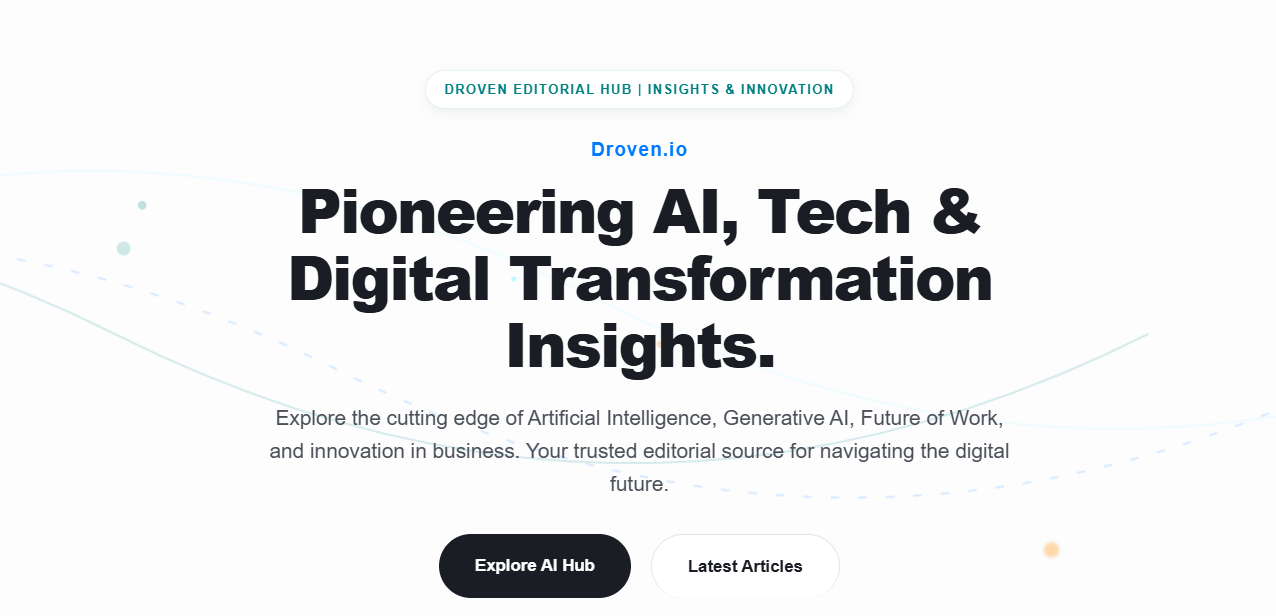
The AI and automation section is the backbone of the site, and it reads like it was built by someone translating vendor jargon for a reader who has a budget to approve but no engineering background. An article on retrieval-augmented generation won’t mention embeddings until it’s explained why a company might care in the first place. That ordering business reason before technical mechanism is the single most consistent thing about the writing across the topics it covers.
Here’s how the coverage actually breaks down, based on what’s visible on the site rather than what other write-ups assume about it:
| Coverage area | What you’ll find | Depth |
|---|---|---|
| AI fundamentals & applications | Plain-language explainers on generative AI, LLMs, use cases by industry | Strong, business-framed |
| RPA & business automation | Workflow bots, process automation, where automation fits vs. where it doesn’t | Solid, practical |
| Machine learning | Conceptual overviews, less on implementation | Introductory |
| Cybersecurity | Risk explainers tied to AI adoption (data exposure, model risk) | Moderate |
| Cloud computing | Present but noticeably thinner than the AI material | Light |
| Digital transformation & careers | Strategy-level pieces, IT career guidance | Moderate |
Two things stand out from that table. First, the site is genuinely broad you can move from an AI explainer to a related security piece without leaving the domain, and that connective coverage is more useful than it sounds, because half the confusion companies run into with AI isn’t about the AI itself, it’s about what it touches. Second, the depth is not evenly distributed. Cloud computing reads like a category the site felt obligated to cover rather than one it set out to own. If you’re researching AI or automation specifically, you’re in the strongest part of the site. If you came looking for cloud architecture guidance, you’ll want a second source before you’re done.
Beyond Automation: How AI Is Changing the Way Businesses Compete
Is Droven.io AI Tool Legit?
Yes, with a caveat worth stating plainly: legitimate and authoritative aren’t the same thing, and Droven.io is clearly the first without fully earning the second.
On the legitimacy question itself, there’s nothing here that resembles a scam pattern. You don’t hand over a credit card to read an article. There’s no forced account creation gating content that should be free. The site behaves exactly like what it is an ad- or affiliate-supported publisher monetizing attention rather than subscriptions. The confusion in search results, where some write-ups describe it as automation software complete with a pricing tier, looks like a case of AI-assisted content generation going wrong somewhere upstream: a writer or a tool inferred “product” from the word “platform” in the site’s own branding and ran with it. It happens more than people realize, and it’s worth flagging as a pattern rather than a one-off, because it means some of what’s circulating about Droven.io online is describing a product that doesn’t exist.
Where the caution actually belongs is authorship. There’s no visible byline system, no author bios with credentials, and no consistent citation of primary sources the studies, the vendor documentation, the regulatory text that a claim would ideally trace back to. None of that makes the content wrong. It just means you’re extending trust rather than verifying it, and that distinction matters enormously the moment a claim has a number attached to it.
How Reliable Is the Content, Actually?
Here’s a useful test: read one of the site’s AI explainers and count how many sentences you’d be comfortable repeating in a client meeting without checking them first. For the conceptual stuff what a large language model does, why RPA struggles with unstructured data, what “human in the loop” means in practice the answer is most of them. The framing lines up with how these ideas are discussed everywhere else that takes the subject seriously, which suggests whoever’s writing this understands the material rather than assembling it from search snippets.
The moment a sentence includes a specific percentage, a named regulation, or a claim about what a particular vendor’s tool can do, the confidence should drop. Not because the number is necessarily wrong it might be perfectly accurate but because there’s no footnote taking you back to where it came from, and an unsourced number is functionally the same as an unverified one, however correct it turns out to be. That’s not a knock unique to Droven.io. It’s true of most mid-tier content sites in this space right now, and calling it out here is less about singling the site out and more about giving you a rule you can actually apply: treat the “why this matters” paragraphs as reliable, and treat every “here’s the stat” sentence as a lead to chase down rather than a fact to cite.
AI Agents: The Future Behind the Code
Droven.io vs. the Alternatives
Nobody researches AI tools by reading one site, so here’s how Droven.io actually stacks up against where you’d otherwise spend that time.
| Droven.io | ChatGPT / AI chatbot | Dedicated tools directory | Vendor blog | |
|---|---|---|---|---|
| Sourcing | Largely unsourced | Varies, often unverifiable | Sometimes sourced | Self-interested, rarely neutral |
| Depth | Introductory | Deep on request, inconsistent | Deep on named tools | Deep on one product only |
| Neutrality | High nothing to sell | Neutral by default | Usually neutral | Low |
| Best for | Mapping a category fast | Fast follow-up questions | Comparing named tools | One vendor’s pitch |
| Worst for | Implementation detail | Structured overview | Category-level education | Objectivity |
The pattern that falls out of that table is simple enough to act on. Droven.io wins the “orientation” stage of research and loses every stage after it. Use it to get literate in a category fast, then switch tools the moment you need to compare named products against each other or defend a claim to someone who’s going to ask where it came from.
Who Gets Real Value Here
If you’re a marketing manager who has to sign off on an automation vendor by Friday and currently can’t tell RPA from a large language model, Droven.io will get you conversational in the topic faster than almost anything else free online. Same story for a student building a foundation, or an operations lead who needs enough vocabulary to ask a vendor sharp questions instead of nodding along to a sales deck.
If you’re an engineer who needs implementation-level detail, or a researcher who needs to cite a source that survives scrutiny, this isn’t your tool, and it isn’t trying to be. The honest move here is reading selectively rather than treating the site as a curriculum pull the pieces that fill a specific gap, skip the rest, and don’t mistake breadth for authority just because it’s comprehensive-looking.
Getting the Most Out of It
Read for the shape of an idea, not the specifics inside it. That’s the single habit that separates people who find Droven.io genuinely useful from people who come away frustrated. Treat any number, date, or named claim as a starting point for your own search rather than something to repeat as-is, and pair the reading with something the site can’t give you a real comparison of named tools, a conversation with someone who’s implemented the thing you’re reading about, a trial account you actually click into. Education is the first step in a longer process, not the whole process, and Droven.io is honestly at its best when you use it that way rather than expecting it to be the final word.
AI Assistant Comparison 2026: What Actually Matters When Choosing the Right Solution
Frequently Asked Questions
Is Droven.io free to use in 2026?
Yes. There’s no paywall, no forced signup, and no sales call required to read the content it functions like a standard ad- or affiliate-supported publisher.
Does Droven.io sell AI automation software?
No. Despite some third-party write-ups describing it with product-style features and pricing, the site itself shows no login, no dashboard, and no purchase flow. It’s a content publisher covering the automation category, not a vendor in it.
Is Droven.io a scam?
There’s no evidence of scam behavior no payment requests, no data-harvesting signup wall, nothing resembling a bait-and-switch. The real caution isn’t safety, it’s sourcing: verify specific claims before you act on them.
How does Droven.io compare to ChatGPT for learning about AI?
They solve different problems. Droven.io gives you a stable, edited overview you can return to and quote consistently; a chatbot answers narrow follow-up questions on demand but can be confidently wrong and offers no organized map of the category. Most people researching AI tools end up using both.
Who owns or runs Droven.io?
That information isn’t clearly published on the site as of 2026. Treat any claim about ownership, funding, or editorial independence you see elsewhere as unverified until you find it stated on a primary source.
Is the 2026 content actually current?
The site leans toward evergreen explainer content that ages slowly by design, which is different from being actively updated. Check the publish or update date on any individual article before assuming it reflects the latest developments in a fast-moving category like AI.
The Bottom Line
Droven.io is a free, broad, genuinely readable starting point for understanding AI and automation and a weak place to stop. It earns its keep in the research phase, before money moves and before a decision gets made, by turning intimidating categories into something a non-specialist can actually reason about. It loses that value the moment you need a source you can defend, a specific tool comparison, or implementation detail deep enough to build on. Use it for what it’s built for: the first read on a topic, not the last one.
 About Carson Derrow

