Installing a new hardware component can feel intimidating if you’ve never done it before, especially when the part comes with its own alphanumeric identifier instead of a simple product name. If you’re trying to figure out how to install 35-ds3chipdus3, this guide walks through the entire process from unboxing to long-term upkeep, so you can get it running correctly the first time and avoid the most common mistakes people run into.
Table of Contents
What Exactly Is 35-ds3chipdus3?
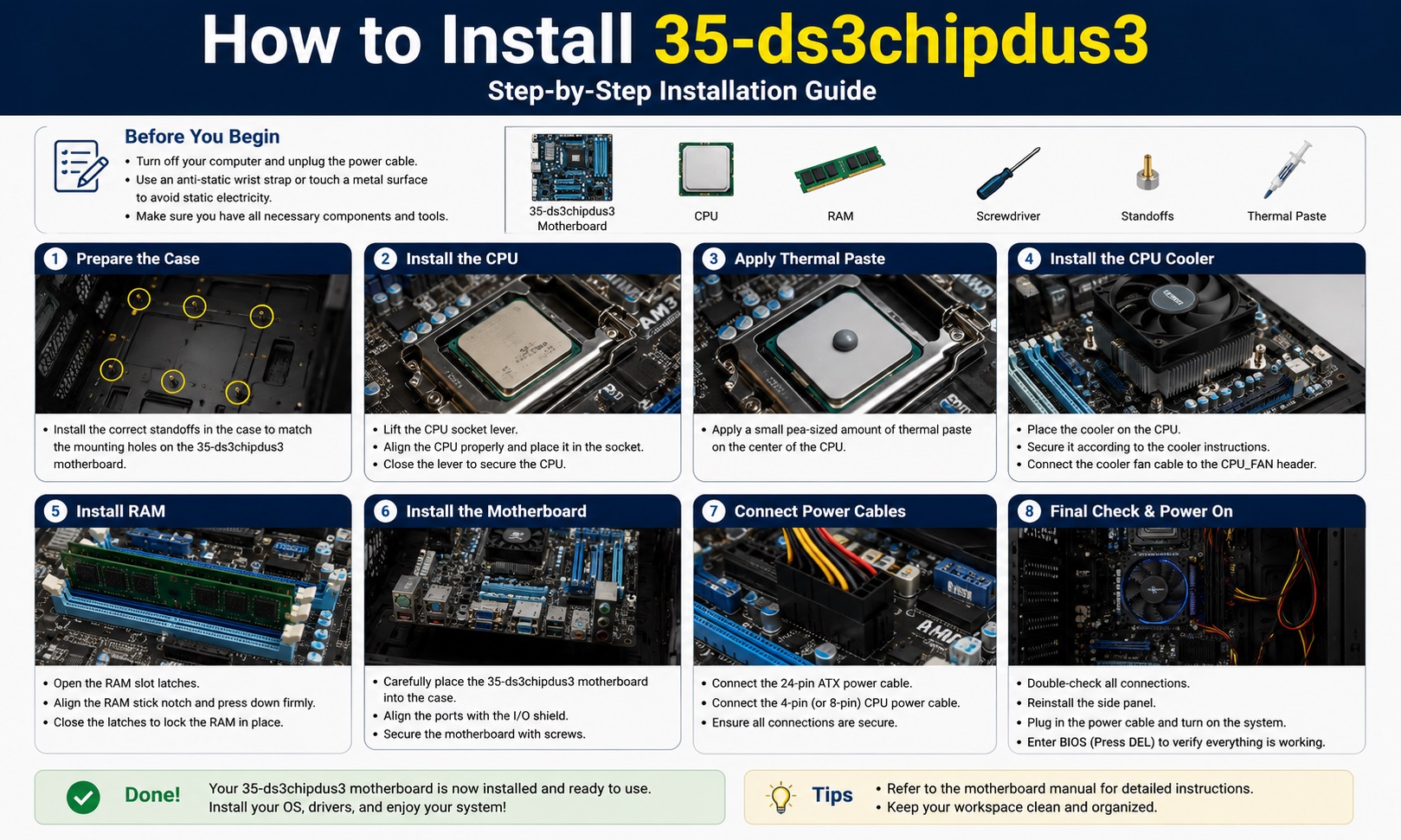
35-ds3chipdus3 is a connector-style component used to link different subsystems on a motherboard so they can exchange data more efficiently. Rather than functioning as a standalone device, it works as a bridge — improving signal stability, reducing latency between connected parts, and helping the system make better use of available bandwidth. You’ll typically find this type of component in performance-oriented builds: workstations, gaming rigs, and servers where consistent throughput matters more than in a basic office machine.
Because it sits in such a central position in the data path, getting the installation right matters. A loose connection or mismatched version won’t always cause an obvious crash — sometimes it just shows up as inexplicable slowdowns or random instability that’s hard to diagnose later. Spending fifteen extra minutes on preparation now is cheaper than spending an afternoon troubleshooting later.
Getting Ready Before You Touch Anything
A little organization before you open the case will save you most of the headaches people typically run into.
- Confirm your hardware lineup. Check your motherboard’s documentation or specification page to verify it actually supports 35-ds3chipdus3 and to identify which physical slot it needs to go in. Installing the right component in the wrong slot is one of the most common avoidable errors.
- Source the part from a legitimate seller. Avoid downloading firmware, drivers, or configuration files from random forums or file-sharing sites — these are common vectors for malware and outdated builds that cause more problems than they solve. Stick to the manufacturer’s official site or an authorized retailer.
- Gather basic tools. Most installations only require a Phillips-head screwdriver and, ideally, an anti-static wrist strap. If your case uses proprietary screws, check whether a precision driver set is needed.
- Back up first. Before opening up any system or making firmware changes, back up your data and, if possible, create a system image. If something doesn’t go as planned, you’ll want a way to roll back without losing work.
Quick Compatibility Reference
| What to Check | Why It Matters |
|---|---|
| Operating system version | Driver support varies between OS versions (e.g., Windows 11 22H2+, macOS Sonoma, Linux kernel 6.x) |
| Physical slot type | The component must match the slot generation and lane width on your board |
| Power delivery | Some versions draw additional power directly from the PSU; verify your supply has spare capacity and the right connector |
| BIOS/UEFI version | Older firmware may not recognize newer components until updated |
Step-by-Step Installation
Once your prep work is done, the actual installation is usually quick — most people finish in under twenty minutes.
| Step | What You’re Doing | Typical Time |
|---|---|---|
| 1. Power down | Shut down and fully disconnect the system from power | 2–3 minutes |
| 2. Open the case | Remove the side panel or relevant access point | 5 minutes |
| 3. Ground yourself and seat the part | Connect the component into its slot | 1–2 minutes |
| 4. Secure it | Fasten with the provided screw or clip | 2 minutes |
| 5. Close up and boot | Reassemble, reconnect power, and turn on | 3–5 minutes |
1. Power Down Completely
Shut the system down fully and unplug it from the wall — don’t just put it to sleep. On desktop towers, hold the power button for a few seconds after unplugging to drain any residual charge sitting in the capacitors. This step protects both you and the sensitive electronics you’re about to handle.
2. Open Up the Case
For a typical desktop, this means removing the side panel, usually held on by a couple of thumbscrews. Laptops and small-form-factor PCs vary widely, so check your specific model’s service manual before prying anything open — some panels are clipped rather than screwed and can crack if forced.
3. Ground Yourself and Insert the Component
Touch a grounded metal surface (or wear an anti-static strap) before handling the part directly — static discharge is invisible but can quietly damage circuitry. Locate the correct slot, line up the connector with its keyed notch so it can only go in one way, and press down evenly until you feel and hear it click into place. Never force it; if it’s not seating smoothly, double-check alignment rather than pushing harder.
4. Lock It Down
Use whatever screw, bracket, or latch came with your motherboard or the component itself to secure it. An unsecured connection can work loose over time from normal case vibration, leading to intermittent detection issues that are annoying to diagnose months later.
5. Reassemble and Power Up
Put the side panel back on, reconnect all cables and peripherals, and power the system on. Your motherboard’s firmware should detect the new hardware automatically during boot — keep an eye on the POST screen for any new device listings.
Configuring 35-ds3chipdus3 After Physical Installation
Getting the part seated correctly is only half the job. Most versions also need to be recognized and configured at the software or firmware level before they’ll function properly.
- Find the configuration menu. On Windows, open Device Manager and look for the component under the relevant hardware category. On other systems, you may need to enter BIOS/UEFI setup during boot (commonly by pressing Del, F2, or F12) and navigate to the hardware or peripherals section.
- Enter any required code carefully. If your component ships with an identification or activation code, type it exactly as printed, paying close attention to capitalization and special characters. Copy-pasting directly from the documentation, rather than typing it by hand, avoids the most common entry mistakes — particularly mixing up zero with the letter O, or one with a lowercase L.
- Confirm it’s working. Most systems will show a confirmation message or simply list the new device as active once configuration succeeds. Run any diagnostic tool included with the component, or check its status in Device Manager / System Information, to be sure everything is functioning as expected.
Choosing the Right Version
Not all 35-ds3chipdus3 units are identical — manufacturers typically release a few tiers aimed at different use cases and budgets.
| Tier | Best For | Performance | Price Range |
|---|---|---|---|
| Standard | Everyday computing, office use | Baseline throughput | $ |
| Performance | Gaming, content creation, multitasking | Lower latency, higher sustained speed | $$ |
| Enterprise | Servers, data centers, scientific workloads | Maximum throughput, built-in error correction | $$$ |
If you’re upgrading an existing installation, check your current version first — it’s usually listed in System Information or the device’s properties panel. Upgrading typically means removing the old component, uninstalling its associated drivers, and installing the new one following the same steps above rather than trying to run both simultaneously.
Troubleshooting Common Problems
The System Doesn’t Detect the Component
- Power down fully and reseat the part, making sure it’s pressed all the way into the slot.
- Try a full reboot — sometimes a fresh boot cycle is all it takes for the system to re-enumerate hardware.
- Double-check you have the correct version for your motherboard; an incompatible version can fail silently rather than throwing an obvious error.
- Update your motherboard’s BIOS/UEFI and chipset drivers from the manufacturer’s support page — older firmware sometimes lacks support for newer hardware.
- If your board has more than one compatible slot, try a different one to rule out a faulty slot.
The Activation or Configuration Code Won’t Work
- Re-check for typos, especially around characters that look similar (0/O, 1/l/I).
- Make sure you’re entering it into the correct field within the configuration utility — some tools have multiple input boxes that look alike.
- Copy and paste the code directly from your documentation instead of retyping it.
- If everything checks out and it still fails, contact the vendor’s support team — there’s a chance the code itself was issued incorrectly.
Performance Dropped After Installation
- Check for resource conflicts with other installed hardware.
- Walk back through the installation steps to confirm nothing was skipped or done out of order.
- Uninstall and cleanly reinstall the latest official drivers.
- Check temperatures — if the component is running hot, improve airflow or clean accumulated dust from the case and fans.
Maintaining 35-ds3chipdus3 Long-Term
Once everything’s running, a small amount of routine upkeep keeps it reliable for years.
- Check for updates regularly. Set a quarterly reminder to look for new firmware or driver releases — these often include performance improvements, bug fixes, and security patches.
- Inspect it physically once a year. Open the case periodically (or whenever you move the system) to confirm the component is still firmly seated, and use compressed air to clear out dust buildup around it and nearby fans.
- Keep a simple record. Note down the version you have installed, the date you installed it, and any configuration codes used. This makes future troubleshooting, warranty claims, or upgrades much faster.
Final Thoughts
Learning how to install 35-ds3chipdus3 correctly comes down to three things: confirming compatibility before you buy, following the physical and software installation steps carefully, and staying on top of basic maintenance afterward. Most installation problems trace back to a skipped prep step or the wrong version, both of which are easy to avoid with a bit of patience. Get those fundamentals right, and the component should run reliably with minimal intervention going forward.
 About Carson Derrow

