The conversation around quantum computing has finally shifted. We’ve moved past the theoretical “what-if” whiteboards and entered the era of quantum utility. For a CTO or innovation lead at a Fortune 500, this isn’t just a buzzword. It’s the difference between a research project collecting dust and a tool that can actually untangle a global supply chain or find a better catalyst for carbon capture.
The problem is that a massive gap still exists between what the hardware promises and what it actually does. If you’ve ever tried to run a workload on a current quantum processor, you know the feeling. These machines are incredibly “noisy.” Heat, magnetic fields, and even tiny vibrations cause qubits to lose their data. Without a lot of help, the results you get back are usually just expensive static.
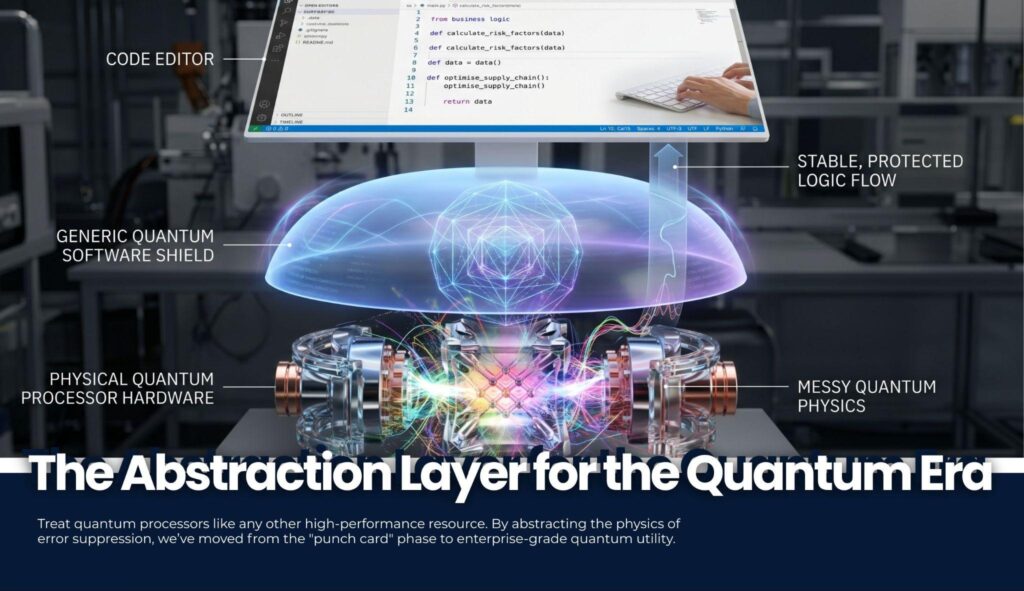
Up until now, the fix was to hire a team of quantum physics PhDs to manually tune the hardware for every single run. That obviously doesn’t scale. If you’re an enterprise software architect, you need abstraction. You need the quantum equivalent of a compiler that handles the messy physics so you can focus on the business logic.
Table of Contents
Dealing with the noise floor
The biggest hurdle in quantum isn’t just adding more qubits; it’s making the ones we have actually behave. Today’s Noisy Intermediate-Scale Quantum (NISQ) devices are powerful but fragile.
Every time you run an algorithm, errors pile up. By the time a complex model for finance or chemistry finishes, the “signal” is buried. Most companies have been told they have to wait for “Fault-Tolerant” machines, which are still years away. Those future systems will use millions of physical qubits just to create one stable “logical” qubit.
But most businesses can’t just sit on their hands for a decade. This is why automated error suppression is the real story right now. We don’t have to wait for perfect hardware if we can use software to make the current hardware act better than it has any right to.
How Q-CTRL and Fire Opal fit in
The most effective way to handle these hardware failures is through advanced quantum control software tools that integrate directly into the execution layer. Using advanced quantum control software tools allows organizations to skip the deep physics lessons and get straight to the data. Q-CTRL built Fire Opal for exactly this reason.
Think of Fire Opal as an automated performance management layer. It doesn’t just try to clean up errors after they happen. It actually changes how the quantum gates are physically executed to stop the errors from happening in the first place. For a developer, this is a huge win. You can take an algorithm written in Qiskit or Braket, run it through Fire Opal, and see a massive performance jump without touching your core code.
The reality of 1,000x gains
The 1,000x figure sounds like marketing fluff, but it’s a reflection of how much “reach” a processor gains when it isn’t fighting its own noise. In benchmarks, Fire Opal has taken algorithms that were failing 100% of the time and made them produce correct answers consistently.
This happens through a few layers of automation:
- AI Calibration: The software senses the noise environment of the hardware in real-time. Quantum noise changes throughout the day, so a calibration from this morning might be useless by lunch.
- Deterministic Suppression: It replaces standard gates with “robust” versions designed to ignore fluctuations in power or frequency.
- Smart Mapping: It routes the algorithm around the “noisy” parts of the chip, picking the most reliable paths for the data to travel.
By 2026, this reached a turning point with the IonQ Forte integration. This partnership changed the “user experience” of quantum. Instead of fiddling with ion trap settings, users just get a stable, high-performing processor. The software handles that 1,000x boost in the background while the user focuses on the results.
Practical use: Finance and Pharma
In finance, risk assessment and portfolio optimization require deep, complex circuits. On standard hardware, these circuits are usually too long; the qubits “die” before the math is finished. With 1,000x better error suppression, those same circuits actually work. You can run more iterations and use more variables, getting a result that actually competes with classical computing.
It’s the same in pharma. Simulating a molecule requires extreme precision. A tiny error in a quantum gate leads to a wrong energy calculation. For a pharma innovation lead, automated suppression is the bridge. It lets their chemists start testing real use cases on IonQ Forte today, rather than waiting for the next decade of hardware breakthroughs.
The need for abstraction
The history of tech is just a long line of abstractions. We went from punch cards to C, then to Python and AWS. Each step meant the programmer didn’t have to understand the physics of the transistor.
Quantum is still in its “punch card” phase. Most platforms expect you to be a physicist. That’s a bottleneck. Your company probably has great software architects, but it probably doesn’t have a hundred quantum physicists.
Fire Opal changes who can do the work. It lets a standard developer treat a quantum computer like any other high-performance computing resource. By abstracting the hardware, you’re future-proofing your strategy. Your team builds the logic for business problems now, and as the hardware improves, the software just keeps squeezing more performance out of it.
Looking ahead at the 2026 landscape
The IonQ Forte integration is a big deal because of how trapped-ion systems are built. IonQ’s hardware has great connectivity, but when you add Q-CTRL’s error suppression on top, it becomes a different beast entirely.
The “winning” quantum strategy isn’t just about who has the biggest fridge or the most lasers. It’s about the software stack. For an Innovation Lead, the goal should be building a “Quantum Ready” pipeline. Get your data and your logic ready now, and use tools like Fire Opal to make sure that when you hit “execute,” you actually get something back that you can use.
These 1,000x gains are the baseline now. As we get deeper into this utility era, the companies using automated suppression are going to pull away from those still trying to tune their hardware by hand.


