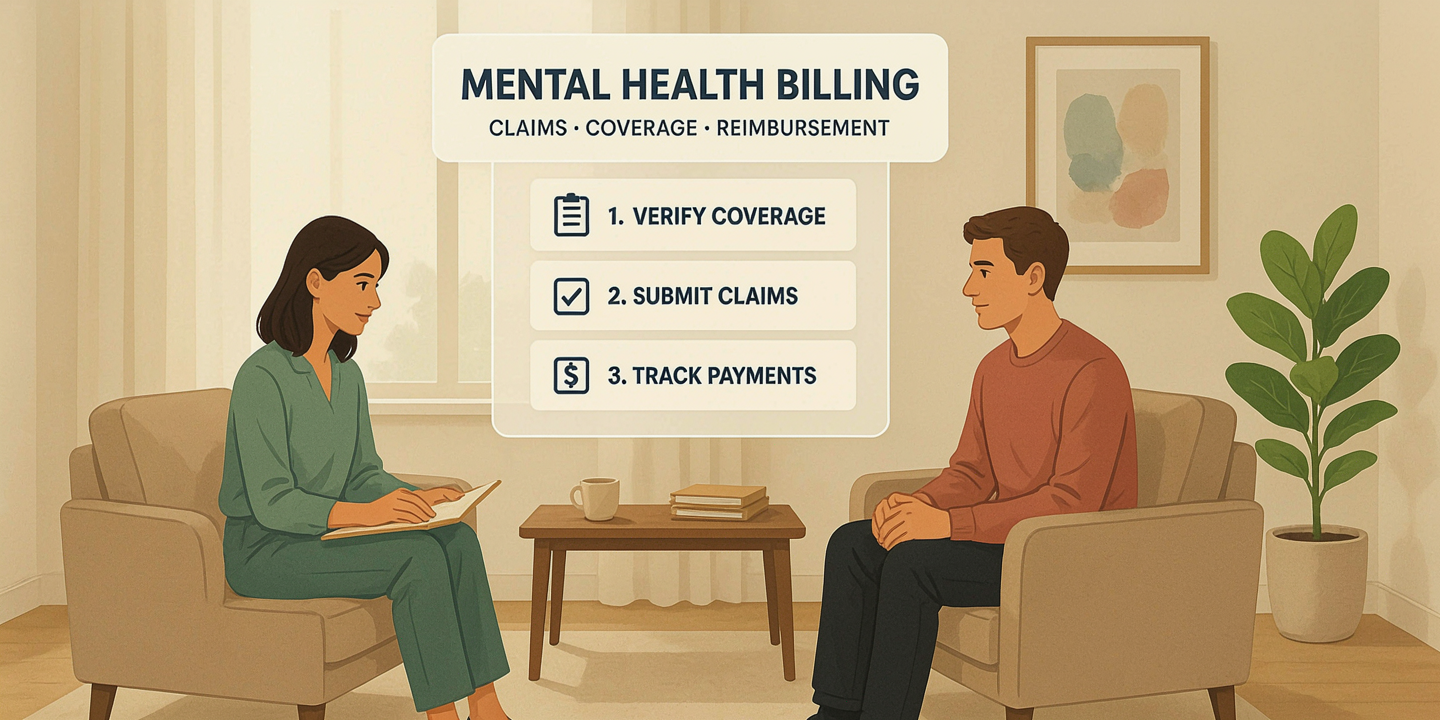
A therapist can spend a full hour with a patient working through a genuine breakthrough, and then spend another hour that same week arguing with an insurance company about why the claim for that session got denied. It’s an imbalance that most people outside the field are not aware of, and it’s the primary reason why mental health billing services are now such a vital component to sustaining a behavioral health practice.
Mental health care is not like most other medical specialties, and providers who attempt to manage mental health care without help will waste time and money that is hard to come by.
Table of Contents
The Coding Problem Nobody Warns You About
Physical exams and procedures are often predictably coded. Psychiatric visits and therapy visits don’t. A medication check will cost differently than a 60-minute psychotherapy session, and each is very different from an intake evaluation or crisis visit. With the add-ons (telehealth, place of service, and time), it’s easy to see why so many claims are getting bounced back the first time they’re submitted.
That’s where psychiatric billing services come in handy. Behavioral health billing teams are familiar with these time brackets and modifiers, and identify mismatches long before the claim ever reaches a payer, just as clinicians are familiar with the criteria for a particular diagnosis, and identify mismatches before a claim is denied 3 weeks later.
Diagnosis Coding Has to Be Exact
As much as it does on the procedure side, it is on the diagnosis side. One of the most prevalent outpatient behavioral health conditions treated is depression. Major depressive disorder does not have one ICD-10 code. It varies according to the intensity and nature of the episode (single vs. recurrent; mild vs. moderate vs. severe; with or without psychotic features; in partial or full remission). The numbers F32, F33, and the digit that follows represent respective episodes and recurrent episodes, respectively, and the rest of the clinical picture the claim is reporting.
The claim may be denied if you get that number wrong, even if the treatment is perfectly appropriate. This little detail has a huge financial impact, and it’s just what a dedicated bill for mental health is designed to uncover.
Why Payers Scrutinize Behavioral Health Claims More
Mental health insurance billing carries a reputation among payers that other specialties don’t deal with in the same way. Historical concerns about overutilization mean psychiatric and therapy claims often face closer review than a routine physical or a minor procedure. Documentation has to clearly justify the level of care provided, the time spent, and the medical necessity behind it.
It’s really hard for a therapist who works alone or a small group of therapists to meet that standard every time and perform back-to-back sessions throughout the day. When managed by individuals who are familiar with both the clinical and the payers’ perspectives, mental health medical billing fills in that gap. It’s not just a submission of a code. It’s all about ensuring that the paper that accompanies that code will stand up should the payer get more involved.
Prior Authorizations Are Their Own Full-Time Job
Some psychiatric drugs, particularly newer antipsychotics, stimulants used for attention-deficit/hyperactivity disorder (ADHD), and some injectable drugs (such as longer-lasting ones), often require prior authorization before a pharmacy can dispense the drug without specific authorization from a provider.
That process involves several follow-up visits with insurance companies, providing clinical justification and following up with them over and over again until you get the approval. None of that includes seeing one patient, but it can be a part of a provider’s week that quietly flies by.
Practices that use mental health billing services usually hand this process off entirely. The billing team tracks which medications need authorization, submits what’s required, and stays on top of follow-ups so the provider isn’t the one stuck on hold.
Denials Follow Patterns, and That’s Useful
Denials in this area often occur for the same few reasons: The time bracket is incorrect when compared to the documentation, or the modifier telehealth is not used, or the diagnosis code is not complete enough to support the treatment charged. If left unattended, these problems don’t just have a financial impact once. They are expensive every time they occur, as they tend to repeat themselves over and over on different claims until something is done about them.
A dedicated team that does billing for mental health services considers denials just like a clinician considers symptoms, as information that indicates the source of the issue. Stabilizing revenue over time involves addressing that root cause and not submitting the same claim containing the same error.
Credentialing Keeps the Whole System Running
None of these matters if a provider isn’t properly credentialed with the payers their patients are using. CAQH profiles need regular updates, payer applications take months to process, and re-credentialing cycles have to be tracked carefully. A lapse, even briefly, means claims get denied on a technicality no matter how well-documented the clinical care was.
This is another area where medical billing for mental health tends to fall through the cracks in smaller practices, simply because there’s no one whose full job is watching these deadlines. Outsourced billing teams typically manage this from start to finish, so providers don’t find out about a credentialing gap only after a stack of claims has already come back denied.
The Real Cost of Getting This Wrong
There’s a clinical argument here, not just a financial one. Providers who are mentally tracking denied claims and overdue authorizations have less presence for the patient sitting across from them. Behavioral health work already asks a lot of attention and emotional bandwidth. Administrative overload takes directly from that same reserve.
Practices that invest in solid mental health billing services tend to see two things move together: fewer denials and better patient care, because the provider’s focus isn’t constantly split between the two.
The Bottom Line
Mental health billing isn’t a simplified version of general medical billing. It requires accuracy in time-based coding, precision in diagnosis codes like those for major depressive disorder ICD 10, and documentation strong enough to hold up under closer payer scrutiny. Therapists and psychiatric providers who bring in experienced psychiatric billing services free themselves from a significant administrative burden, one that otherwise eats directly into the time and attention their patients deserve.


