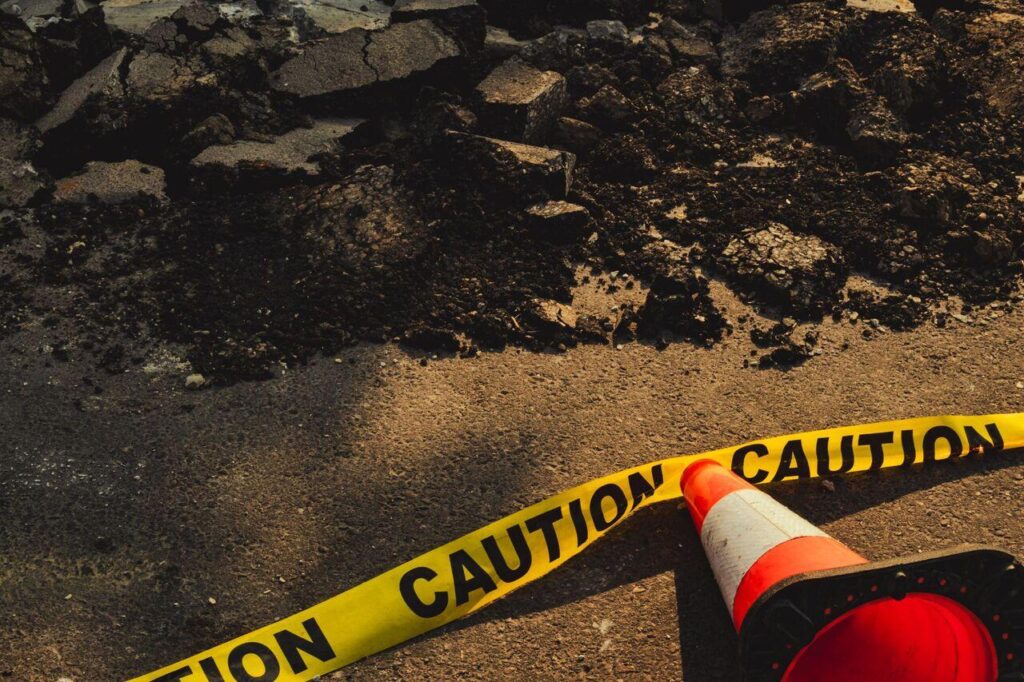
It sounds obvious, but a barrier only does its job if someone can actually see it. If you’re buying off-brand rather than a reliable product, like Seton’s temporary hazard warning tape, it may read clearly at 3pm yet all but disappear by 7pm. A perimeter nobody can see is, of course, the same as having no perimeter at all.
Fluorescent colour alone isn’t enough
Fluorescent orange and yellow work by taking in the UV and visible light and then re-emitting it, which is what makes them so much brighter than an ordinary colour during the day. Once the ambient light drops away though, it has nothing left to absorb and reflect. A fluorescent surface with no external light source cannot work with just a dull orange or yellow surface.
This is what underlines the EN ISO 20471, the recognised standard for high-visibility workwear. It treats fluorescent background material and separate retroreflective material as two entirely different jobs rather than one, then scales the combined area of the two across the three classes. Those classes are Class 1 (lowest visibility) up to Class 3 (highest).
Retroreflective strips then bounce the vehicle’s headlights or perhaps a torch straight back at their source, meaning the barrier is legible after dark, but is why the better warning and barrier tapes carry a retroreflective or diagonal-stripe element rather than relying on fluorescent colour alone.
Site lighting complicates this further though unfortunately – it cannot just solve it outright. HSE’s own construction guidance is explicit in that lighting arrangements should not change the apparent visibility of safety-related items, and that shadow areas need supplementary lighting because a shadow can hide a hazard as effectively as darkness can. A floodlight aimed past a barrier line, rather than along it, can leave the one thing that needed to be seen sitting in the dark it was meant to eliminate.
When a perimeter isn’t visible
The consequences of getting this wrong are quite real. Alchemist DB Limited was fined £20,000 plus some £5,000 in costs (Luton Magistrates’ Court) when a labourer drowned in a rainwater-filled excavation on a Hertfordshire site. HSE found no dedicated lighting, excavations crisscrossing the site without any designated safe walkway, and boards used as bridges over the open ground that were slippery, bowed underfoot and had no handrails (a hazard that existed on the ground but nowhere marked once that daylight faded). Though it is an extreme outcome, the failure here is behind a pattern. Ultimately, a hazard boundary that exists on a site plan and nowhere else after dark.
HSE’s figures are frequently double digits annually for workers being struck by a moving vehicle in and from being struck by a moving object, both are fairly steady year on year. Commonalities are poor visibility and inadequate segregation between people and vehicles, along with hazards, as these are cited most often as recurring factors alongside them. It makes intuitive sense, and it’s particularly egregious to be negligent on given that, to some extent, it’s a one-payment passive risk management once you get the procurement right (that isn’t to say on-going risk assessments aren’t needed, especially as the environment evolves). Visible exclusion zones that read clearly at midday and effectively vanish at dusk are not protecting against the risk it was set up for during a significant part of the working day.
Building a perimeter that stays visible all night
A perimeter that holds up after dark isn’t just about the reflective warning tape though as it’s also important in how it is fixed. Tape strung loosely between whatever is nearest tends to sag and twist, which turns its retroreflective face away from the angle a driver or pedestrian is actually approaching from, so fixing points need to be upright and close enough together that the line does not bow in wind or foot traffic.
A continuous run, to some extent, matters more than a bright one because a single unmarked gap is where someone will step through, regardless of how well the rest of the boundary is marked. Diagonal-stripe and chevron patterns read from further away and at a wider range of viewing angles than a plain colour block, which is worth the marginal extra cost on any boundary that will still be standing after the site empties for the night. If you are still weighing up which tape format (e.g., fluorescent barrier tape) suits a given boundary, a look at the main types of barricade tape can cover the trade-offs in more detail. And because site lighting can just as easily undercut a barrier as support it, it is worth checking, once, after dark, that the exclusion zone is actually visible from where people will approach it. So, not just from where it was hung.
Getting the boundary right the first time, in daylight, is how you implement it, not test it. Like any outdoor hazard marking, you then need to walk the same line after dark and checking it still reads as a boundary rather than a suggestion.


