
Founders assume they need a technical partner from day one, or their idea will never get off the ground. That’s not true anymore.
You can build an MVP without a tech co-founder, especially since MVP development services exist to bridge that gap. The question is how to do it right without wasting time or money, as your MVP’s success now depends on how well you guide the process.
This article explains how you can accomplish this.
Table of Contents
What a Tech Co-Founder Usually Does
A tech co-founder handles the technical side of building your product:
- Makes architecture decisions and evaluates technical trade-offs
- Manages the development process
- Translates your business vision into working software
- Pushes back on unrealistic features and scope creep
- Deploys the product and handles technical problems as they come up
Without one, these responsibilities don’t disappear. They shift to you and the MVP team or experts you bring on board. You need to understand enough to make smart decisions, ask the right questions, and spot problems before they derail your timeline.
Steps to Building Your MVP
Here’s how to handle each stage of development when you’re on your own:
Step 1: Validate Your Idea Before Writing Any Code
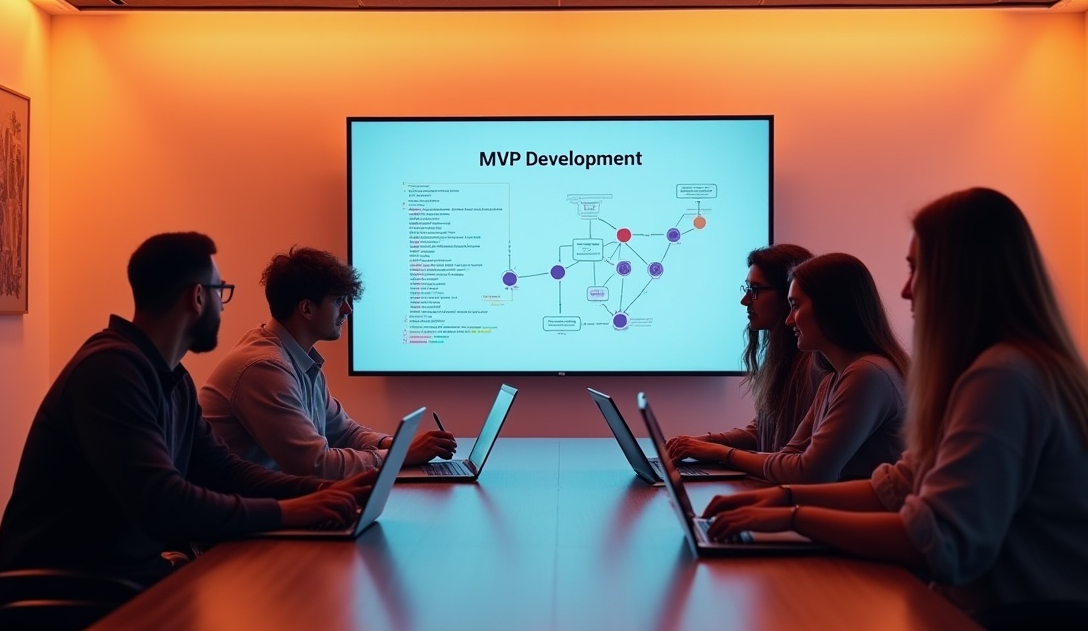
SOURCE: Freepik
ALT TEXT: A pair of developers looking at an MVP product workflow
This step proves people actually want what you’re building before you spend a dollar on development. A tech co-founder would normally stress-test assumptions, identify technical risks early, and validate whether the idea is even buildable.
In your case, you should run validation yourself using no-code tools and real customer conversations.
- First, prove demand by talking to potential users about their problems, rather than your solution. See if they have pain points they are willing to pay to fix.
- Second, you can create surveys using Google Forms or Typeform to get structured feedback about their problems. Gauge interest with a landing page (using Carrd or Webflow) that explains your concept, and include a sign-up form.
You can take this to the next level by building a Figma mockup that explains the flow of your idea. Show these to users and see if they’re interested.
If nobody signs up, clicks, or shows real interest at this stage, building the product won’t change that, as CB Insights indicated, 35% of apps generally fail due to the lack of market. Validation requires curiosity, honesty, and a willingness to hear “no” before you’ve invested too much.
Step 2: Define Your MVP Scope with Ruthless Clarity
Scope definition decides exactly what your MVP will do and what it won’t do. A tech co-founder will help polish your product scope, translate features into technical timelines, and support prioritization.
Without a co-founder, all you need to do is strip your idea to its bare essentials. Write down every feature you think your product needs, and cut it in half. Your first version must be the simplest version that delivers value.
This clarity becomes your blueprint when you start working with an MVP development team. The clearer your scope, the faster and cheaper your build. Create the following for them:
- User flow mapping: Sketch out the exact steps someone takes to get value from your product. Anything outside that core flow can wait.
- Priority matrix: Rank each feature according to importance in your Version 1. Only build your top features.
- Timeline: Give yourself a deadline of 8 to 12 weeks. Any feature that doesn’t fit gets pushed to version two.
Focus on the one action that defines success for your product.
Step 3: Choose Between Vibe Coding, Low-Code, or Custom Development
Platform choice determines how quickly you can build, how much it costs, and how easily you can scale later. A tech co-founder would evaluate technical options and recommend the right approach based on your long-term vision.
Weigh trade-offs between speed, cost, flexibility, and scalability based on your specific goals. You have three paths:
- Vibe coding platforms like Lovable and Bolt.new work when you need to validate an idea in two to four weeks. They’re fast and cheap but limited in terms of features. You’ll hit walls quickly if your product needs complex features or serious scale.
- Low-code platforms like OutSystems and Mendix give you more flexibility than no-code. They work well for internal tools or simpler apps. You still face platform constraints, but you have more room for growth as you have foundational code to work with by the time you proceed to full app development.
- Custom development through MVP software development services gives you full control. It costs more upfront but scales better. Choose this when you’re planning to raise funding, need specific integrations, or know you’ll outgrow a platform in six months.
Hostinger data found that developers spend 90% less time creating both no-code and low-code platforms. As such, most non-technical founders start with no-code for validation.
But if you’re serious about scale, hiring an MVP development services partner to choose for you makes more sense from the start. Don’t trap yourself in a platform you’ll outgrow quickly.
Step 4: Find and Vet Your Provider or Development Partner
Your development partner becomes your tech co-founder by proxy. They translate your vision into working software and make real-time decisions as problems arise.
- Look for teams with a portfolio of similar projects. Have they built MVPs in your industry? Ask to see live examples, not screenshots.
- Check if they use AI coding tools in their workflow. Knowledge of tools like GitHub Copilot and Cursor can potentially pave the way for a faster development timeline.
- Check if they explain things in plain language or hide behind jargon. Test this in your first conversation.
- Ask about their communication cadence. Will you see progress weekly or wait months for updates?
Working with professional MVP development teams means getting strategic partners who guide technical decisions when you can’t make them yourself.
Step 5: Stay Engaged Throughout Development
You need to understand what’s being built and why. A tech co-founder would own the technical roadmap and make daily decisions to keep the project moving. You’re the product owner, so you make the final calls on everything: features, UX, even priorities.
When checking development progress, you should:
- Schedule weekly check-ins to ask what’s been built and if there are any blockers.
- Evaluate the timeline regularly to see if you’re on track or if you need to re-prioritize.
This balance keeps the project on track without you needing to learn to code. You stay in control of the vision while trusting the technical execution to people who know what they’re doing.
Step 6: Launch, Learn, and Iterate Quickly
Your MVP launch isn’t the finish line. It’s the starting line. A tech co-founder would deploy the product, monitor performance, and implement changes based on user feedback and technical data. Define success metrics upfront and use data to guide your next moves:
- Track core feature usage. Are people using the main feature you built? If not, why?
- Track drop-off points. Where do users stop using your product? That’s where you need to improve.
- Track feature requests. What are users asking for that you didn’t build?
- Track unused features. What did you build that nobody uses?
Use this data to prioritize your next iteration. Double down on what works and cut what doesn’t. Thanks to vibe coding tools, you can introduce new features quickly – but your development team may still need to use advanced AI tools and custom coding to ensure you have a market-viable product.
Quickly doesn’t begin to describe the urgency of this matter. When you launch, you have to compete with brutal average churn rates: Business of Apps revealed that 96.3% of iOS users quit using an app by Day 30, while 97.9% of Android users do the same within that period.
This is where MVP app development services perform. They can pivot quickly based on real-world feedback without requiring you to build a full in-house team.
Speed matters more than perfection at this stage. The faster you learn, the faster you improve.
Finding the Right Partner
Not having a tech co-founder doesn’t mean doing it alone. It means choosing the right people or team to fill that role strategically.
Look for a partner who understands lean startup principles, communicates clearly, and has experience building MVPs that actually launch. The right partner doesn’t just write code; they help you make smarter decisions, avoid common mistakes, and get to market fast.
Your job is to own the vision, validate the market, and stay involved in the process. The technical execution can be handled by people who do it for a living.

