If you run ecommerce for a mid-market Shopify Plus brand with a large, fast-changing catalog, product discovery can have a direct effect on revenue. Shoppers who cannot find the right item leave, and a catalog with tens of thousands of SKUs makes that risk more common. The category that used to be split across search vendors, recommendation engines, and merchandising tools is converging. Stronger options now blend semantic search, AI-assisted recommendations, and merchandising control into one experience layer.
This article gives you a practical framework for evaluating that category. We explain what hybrid search means, which features to test before you sign anything, and how to match a platform to your use case and constraints rather than to marketing claims. The goal is a calm, repeatable way to build a shortlist and make a decision.
Table of Contents
Key takeaways
- Test search quality first. Run real shopper queries against each platform before you compare feature lists. Discovery quality is one of the biggest drivers of revenue impact.
- Understand hybrid search. Elastic describes hybrid search as running full-text and vector search in one request, then combining the results. That blend handles both exact matches and semantic intent.
- Treat experimentation as a requirement. A/B testing on rankings, recommendations, and merchandising rules is how you prove incremental revenue rather than assume it.
- Know where Shopify’s native tools fit. Shopify’s free Search and Discovery app lets merchants customize storefront search, filters, and product recommendations, which can be enough for smaller catalogs.
- Plan for the data and consent reality. On April 22, 2025, Reuters reported that Google would keep third-party cookies in Chrome and drop its standalone choice prompt, so first-party behavioral data still matters for on-site personalization.
How we evaluated
We focused on the factors that move revenue for high-SKU stores, not on long feature checklists. If you build your own test, use a similar plan.
- Search quality on real queries. Assemble about 50 representative queries from your site search logs, including brand terms, long-tail descriptions, and misspellings. Score relevance for each.
- Semantic intent handling. Test queries phrased the way shoppers actually talk, not just exact product names, to see how well vector search and natural language understanding work.
- Zero-results recovery. Check what each platform returns when a query has no exact match. Empty results pages lose sales.
- Category merchandising rules. Confirm you can pin, boost, bury, and sort products on collection pages without engineering help.
- Experimentation workflow. Look for native A/B testing on rankings and recommendations, plus clear reporting.
- Shopify Plus readiness. Validate support for Markets, metafields as facets, and variant grouping, along with any uptime or latency commitments.
A buyer’s framework for 2026
Before you compare vendors, decide where your store sits on a few practical axes.
When native Shopify is enough. The free Search and Discovery app covers storefront search customization, filters, and product recommendations. For a focused catalog with simple navigation, that may be all you need.
When to move to a dedicated platform. Large catalogs, frequent inventory changes, multi-region selling, and a need for granular merchandising usually push teams toward a specialized search or experience platform.
How to validate hybrid search. Ask each vendor to demonstrate keyword retrieval, often BM25, and vector retrieval working together on your queries. Elastic frames hybrid search as combining full-text and vector results in a single request, which is the behavior you want to confirm.
Facets and filters that matter. For high-SKU stores, faceted navigation built from your real attributes, including metafields, is what makes browsing usable.
Experimentation and governance. Decide who owns merchandising rules, how changes get tested, and how the team rolls them back if performance drops.
Data and consent basics. Even with third-party cookies persisting in Chrome for now, on-site personalization should lean on first-party behavioral signals and clear consent handling.
1. Constructor
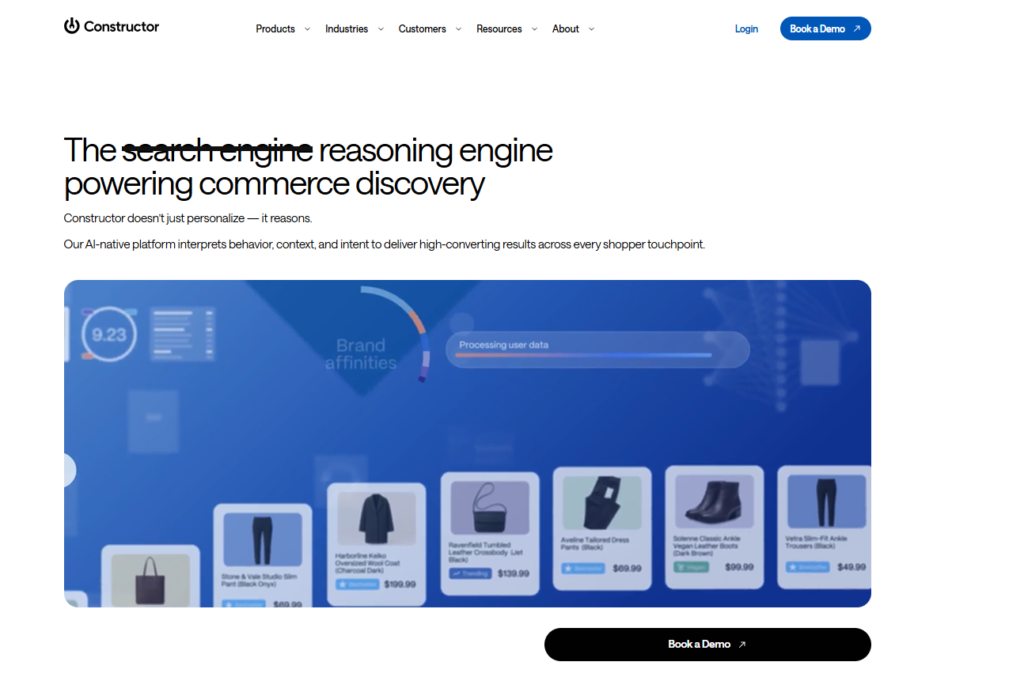
Constructor positions itself as AI-led product discovery for enterprise catalogs, with ranking models that learn from shopper behavior and tie outcomes back to revenue. The platform emphasizes attribute enrichment, autocomplete, recommendations, and collections, all powered by machine learning trained on real engagement data rather than static rules.
Shopify integration is often handled through partner work or custom implementation rather than a one-click app, which suits brands willing to invest in deeper engineering work. Constructor tends to fit retailers with high-SKU catalogs, complex taxonomies, and dedicated discovery or data teams who can act on its model outputs.
Pros
Built for large, complex catalogs where ranking toward business outcomes is the priority. It can fit teams that want discovery tuned to revenue goals.
Cons
Enterprise orientation can mean heavier onboarding. Confirm the depth of native Shopify Plus support for your specific Markets and metafield needs during evaluation.
2. Nosto
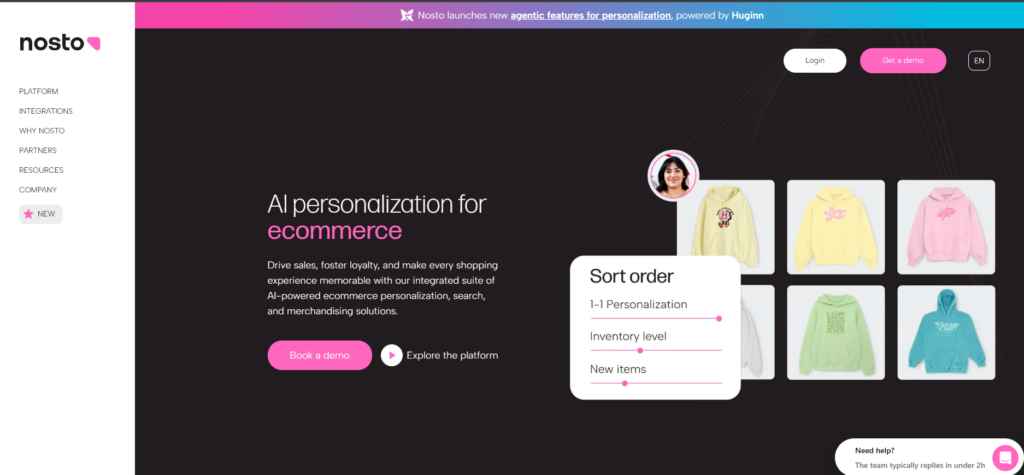
Nosto is the agentic Commerce Experience Platform that brings together Personalized Search, Product Recommendations, and Category Merchandising in one unified layer designed to remove the data silos that traditionally fragment ecommerce stacks.
It’s an experience AI intelligence engine uses behavioral signals to adjust search and recommendation results in real time, and its AI commerce agent, Huginn, orchestrates a network of purpose-built agents that accelerate the path from ideation to execution across the customer journey.
Personalized Search combines natural language processing, machine learning, automation, and merchandising rules, and its content search can use both keyword and vector search to match queries with relevant content.
The platform supports more than 1,500 brands in over 100 countries, including Kylie Cosmetics, Marc Jacobs, O’Neill, and Diane Von Furstenberg, with seamless Shopify ecosystem integrations across Klaviyo, Tapcart, and Yotpo. If you want one platform for AI-assisted recommendations, personalized site search, and merchandising on Shopify Plus, Nosto is worth testing against search-first stacks.
Pros
Unifies search, recommendations, and merchandising in one experience layer, which can reduce the number of vendors you need to connect. Nosto says it is the only Shopify Plus Certified App Partner for commerce experience management.
Cons
A combined platform asks you to commit to one ecosystem. If you only need search, a narrower tool may be simpler.
3. Algolia
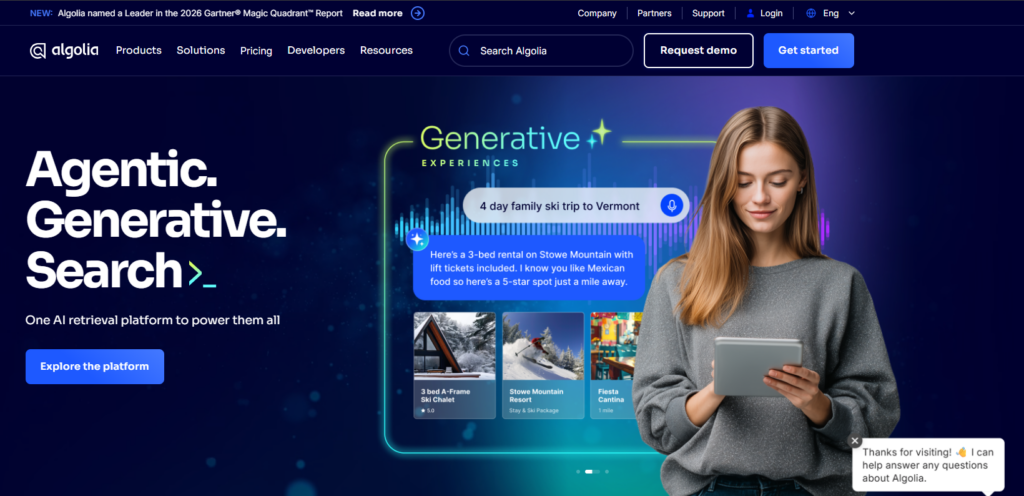
Algolia is a search-first platform with neural and AI features layered on top of fast keyword retrieval, designed for teams that prioritize developer flexibility and millisecond-level response times. The platform supports federated search, autocomplete, query suggestions, dynamic re-ranking, and personalization, with extensive API documentation and SDK support across major frameworks.
Shopify integration is available through dedicated resources and partner-developed connectors, though deeper customization typically requires engineering work. Algolia tends to suit brands with mature in-house developer teams that want full control over the search experience, ranking logic, and integration depth, rather than turnkey merchandiser workflows.
Pros
Speed is a core strength. Algolia says a single Recommend API call returns a ranked list in under 10 milliseconds. Developer tooling is mature.
Cons
Request and record allowances can drive cost as catalogs and traffic grow, so model your volume carefully.
4. Bloomreach Discovery
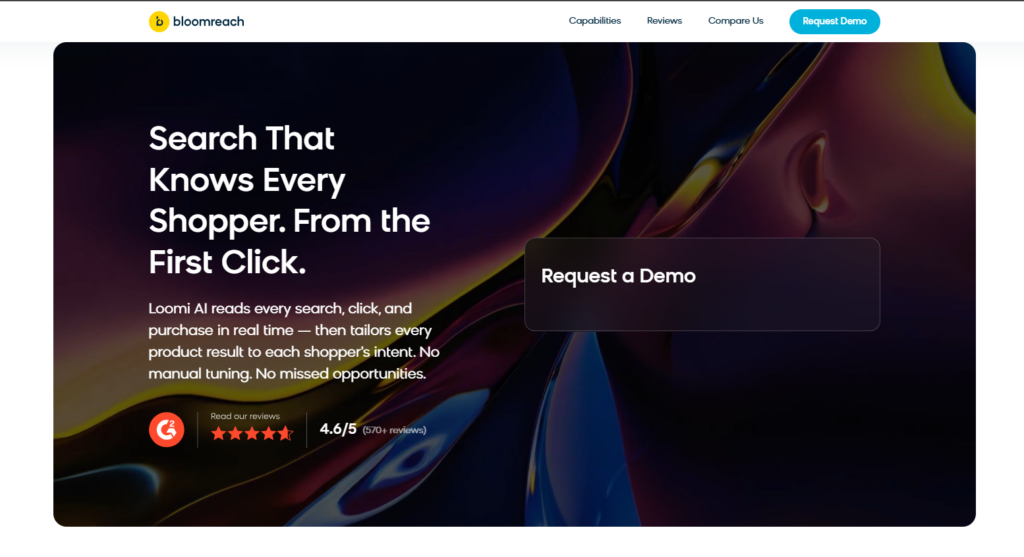
Bloomreach Discovery brings search and merchandising together within a broader commerce experience cloud that also includes content and engagement capabilities. The platform leans into omnichannel personalization and structured experimentation, with native A/B testing, AI-driven recommendations, and merchandising controls designed for retailers running coordinated campaigns across web, email, and mobile.
Bloomreach launched Loomi AI for Shopify, positioning it as an embedded app that uses generative AI to personalize the customer journey from discovery through post-purchase. The platform tends to fit larger brands that want unified personalization, customer data, and content management within a single vendor relationship rather than a stitched-together stack.
Pros
Suited to brands that want personalization across channels and a structured testing culture.
Cons
Enterprise scope can be more than a single-store team needs. Scope the implementation carefully to avoid paying for unused breadth.
5. Searchspring
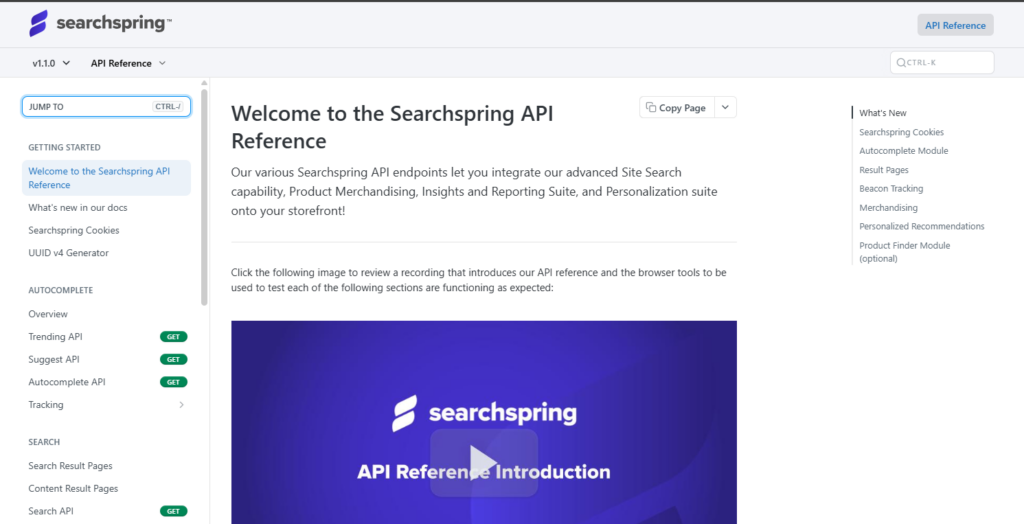
Searchspring focuses on merchandiser control over search, category pages, and product discovery experiences, with tooling built specifically for retail teams rather than developers. The platform offers visual merchandising interfaces, drag-and-drop product positioning, rule-based boosting and burying, and automated sorting that lets merchandisers manage discovery without engineering tickets.
Mobile support and sync tooling are designed for catalogs that change frequently, with fast indexing for new products, price updates, and inventory shifts. Searchspring tends to fit mid-market retailers whose merchandising teams want hands-on control over the storefront experience, especially during high-traffic periods like seasonal launches, promotional events, and holiday shopping windows.
Pros
Merchandiser-friendly controls. Searchspring states 99.9% uptime and sub-100ms response times, even during peak events like Cyber Monday. Its Delta Sync aims to shorten sync times so recent updates surface faster in search and merchandising.
Cons
If your priority is advanced vector search and AI ranking, confirm those capabilities map to your test queries.
Comparison at a glance
Capability |
Constructor |
Nosto |
Algolia |
Bloomreach |
Searchspring |
| Search approach | AI-native ranking | Keyword + vector | Keyword + AI/neural | Search + AI | Search + merchandising |
| Shopify Plus support | Via partners | Shopify Plus Certified App Partner | Integration resources | Loomi AI for Shopify app | Shopify support |
| Category merchandising | Yes | Yes | Yes | Yes | Strong merchandiser controls |
| A/B testing | Yes | Yes | Yes | Yes | Yes |
| SLA / latency claim | Contact vendor | Not stated here | Recommend under 10ms | Contact vendor | 99.9% uptime, sub-100ms |
| Pricing disclosure | Quote | Contact sales | Public Build plan | Contact sales | Contact sales |
Alternatives worth a look
Klevu states full compatibility with Shopify Markets, which helps multi-region Plus stores, and its Shopify integration notes API limits of up to 600 calls every 5 minutes, or 1,200 for Shopify Plus accounts. Coveo, Netcore Unbxd, Clerk.io, and Findify also serve discovery and personalization use cases, with varying pricing transparency. Most require a sales conversation for exact figures, so treat published numbers as starting points.
Implementation gotchas on Shopify Plus
Even a strong platform can stumble on Shopify Plus specifics. Validate these before launch. For a wider market scan, compare personalization platform options against the checklist below.
- Markets and multi-currency. Confirm the platform respects your Markets setup so search and pricing stay correct per region.
- Metafields as facets. Check that custom metafields can become searchable, filterable facets for your catalog.
- Variant grouping. Decide how variants should appear in results and confirm the platform handles grouping the way shoppers expect.
- Analytics and tagging. Plan first-party event capture and any server-side tagging early.
- App load performance. Test how the integration affects page speed under real traffic.
How to decide
Choose by use case, not by hype. Start with your 50 real queries and run a focused 30-day pilot against two finalists. Measure relevance, zero-results recovery, merchandising control, and tested revenue lift. If your catalog is modest, Shopify’s native tools may carry you. If discovery, recommendations, and merchandising are one connected problem, a commerce experience platform like Nosto deserves a place on your shortlist next to search-first options. The right answer is the one your shoppers feel is faster, more relevant discovery.